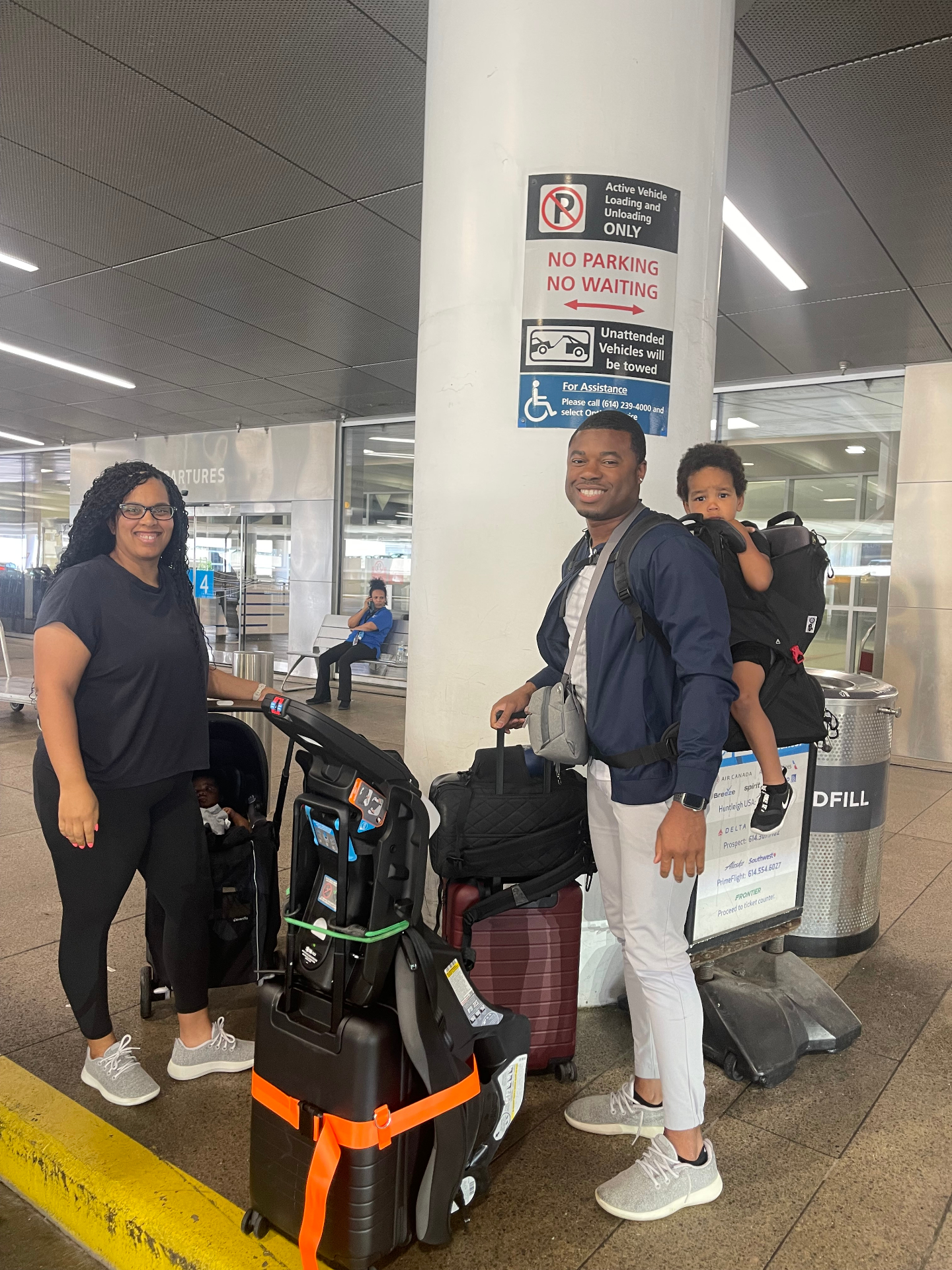
Airplane Seat Configuration for a Family of Four
Our favorite seating arrangement for long-haul flights with toddlers and young children—and why it works.
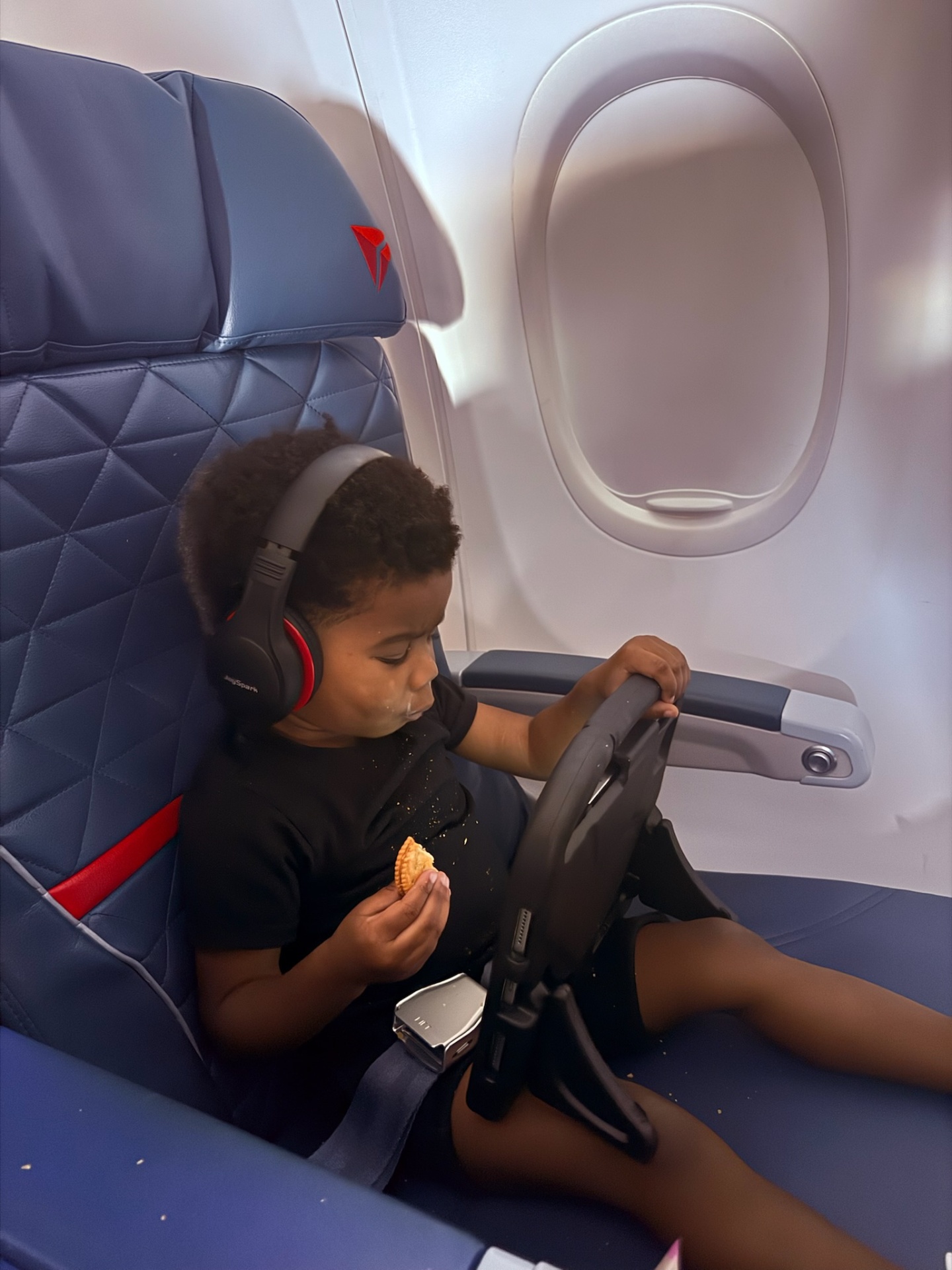
For the first couple of years, seating was the one thing we never had to think about. Under two, both boys flew as lap children: cheaper, simpler, one less seat to negotiate and one warm body asleep on us for most of the flight. Then Avery turned two, and overnight we became a true family of four. Four tickets, four seats, and a question we'd somehow never had to answer before: who sits where?
We have since tried, I'm fairly sure, every possible arrangement. Here's what all of them taught us.
On planes with two seats to a row, you can go side by side or front to back. We prefer front to back, for one specific and slightly petty reason: if Avery is going to kick the seat in front of him, I would much rather it be Preston's seat, or mine, than a stranger's. We split the boys up by parent — Preston with me, Avery with Kyle — and stack the two pairs in a line.
When the row has three seats, the math gets harder. We've done the version where I take both boys and Kyle sits across the aisle, and it is my least favorite by a wide margin: one adult, two small kids, and no backup within arm's reach. We've also done window and middle with a stranger on the aisle, which works fine, though it turns every bathroom run into a small negotiation. Wherever we end up, we almost always choose a window. If a child needs to lean on you to sleep, you want something to lean on yourself.
But our actual favorite surprised us, because it is the one that looks the least like sitting "together." We split the boys into separate parts of the plane entirely: Preston with me, Avery with Kyle, far enough apart that we are usually out of each other's sight. At home, antagonizing each other is their favorite pastime. It is considerably less charming at 35,000 feet, where there is nowhere to send anyone to cool off. Real distance, not just a row or two, is what turns a nine-hour needling contest into two calm, separate flights.
What makes it work is that neither pair depends on the other. We each carry a backpack packed with our own essentials and our kid's, so there is never a reason to get up and track down the other parent mid-flight. Whatever Preston needs, I have; whatever Avery needs, Kyle has. Two self-contained little travel units, moving through the same flight on their own terms. Peace, it turns out, is a seating strategy.
This also lines up with how we book. We buy our tickets in pairs rather than as one block of four, and it seems to give us a better shot at an upgrade. It is easier for an airline to move two people up than four. Two seats here, two seats there, each pair an adult and a child.
One hard-won warning if that upgrade does come through: check your seats before you board. More than once, we have been bumped up and then quietly separated from the child we were booked with. Both of us in the nicer cabin, just not next to each other, even though we had bought the seats together. It has always sorted itself out at the ticket counter. But that is exactly where you want to sort it, at the counter and not on the plane, where the only fix left is asking a stranger to give up a seat they paid for. A thirty-second look at your boarding passes saves you that entire conversation.
None of this is the part of travel anyone daydreams about. But getting the seating right is quietly one of the biggest levers we have over how a travel day actually feels. So these days we've stopped chasing the perfect seat map. We book for peace, keep the boys well out of range of each other's mischief, and check our tickets before we get on.
- book your seats in pairs, not as a block of four, for better upgrade odds
- after any upgrade, check your boarding passes to be sure each adult and child actually landed together