Block Guides
Venice
Exploring Venice with our two-and-a-half-year-old and three-and-a-half-month-old.
From an overnight flight during parental leave to an unforgettable water-taxi arrival, Venice became the place where we learned that our expanded family could still cross an ocean, navigate something unfamiliar and see the world together.
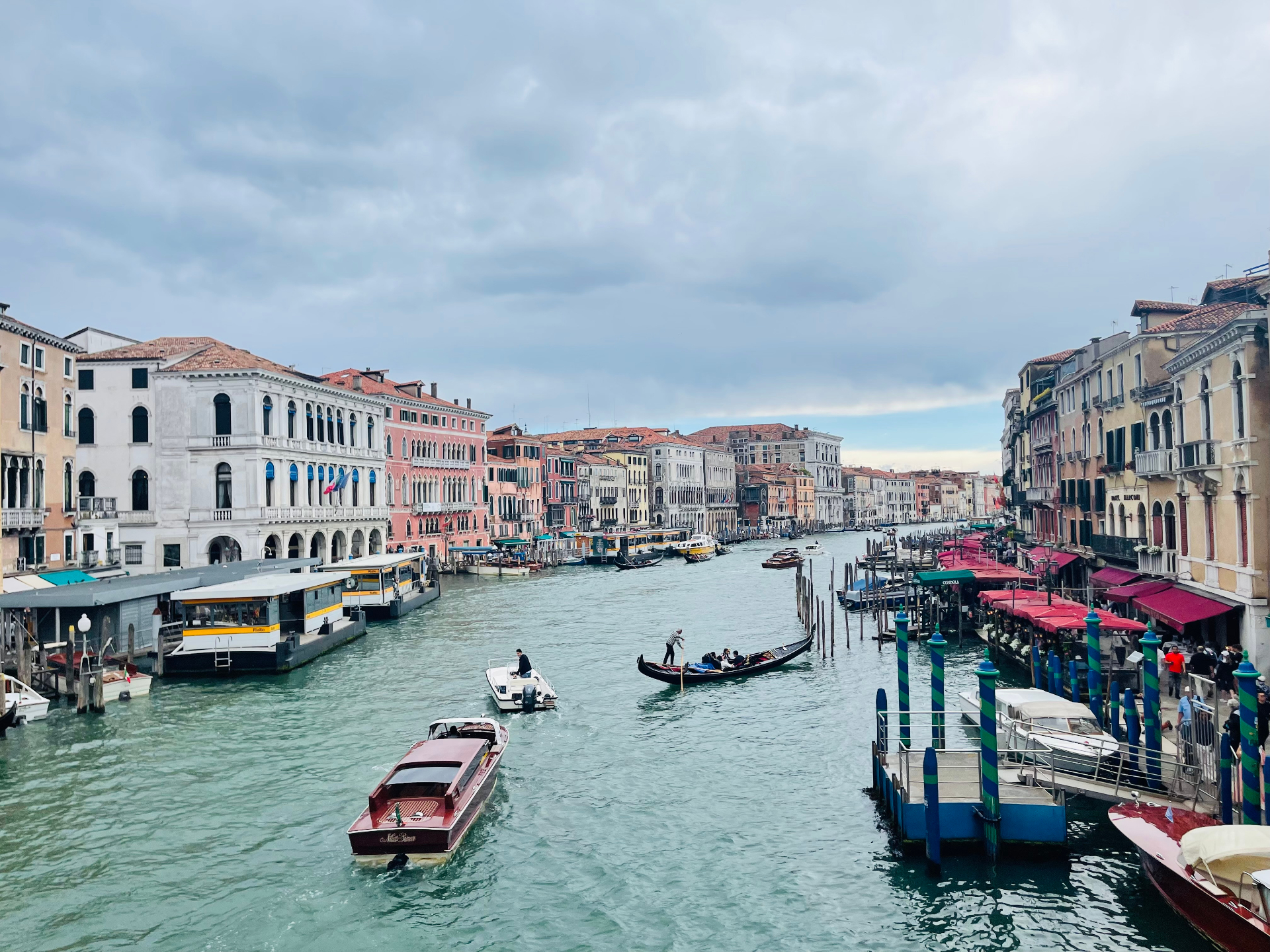
The Trip That Began After Avery Arrived
Venice was the first place we traveled as a family of four.
We arrived on May 31, 2024, with our two-and-a-half-year-old son, Preston, and our three-and-a-half-month-old son, Avery. The trip began almost immediately after Kyle finished the school year and approximately halfway through my parental leave. For once, the two of us had an extended period away from our ordinary work demands at the same time. We did not know when that kind of window would appear again.
The plan was ambitious: more than 30 days in Europe, beginning in Venice and continuing through Bologna, Lake Garda, the Dolomites, Lake Como, Switzerland and France before returning home from Zurich on July 1. But we did not book the trip before Avery was born. We knew I would deliver by C-section, and we wanted to meet our baby, understand my recovery and see how our family was adjusting before turning the idea into reservations. About three-and-a-half to four weeks after Avery arrived, we decided we were ready enough to commit.
Ready did not mean free of doubt. It meant we understood that raising an infant and toddler would be difficult at home or abroad. If we were going to navigate feedings, sleep, big feelings and potty training either way, we might as well do it with Venice — and the rest of Europe — in the background.
The confidence we carried from earlier trips belonged to a family of three. Venice would be the first test of what travel looked like after our family changed.
Our Route
Venice opened a 30-plus-day European journey in the summer of 2024: Venice → Bologna → Lake Garda → Ortisei → Lake Como → Faulensee → Colmar → Zurich, May 30 to July 1. We flew from Columbus through Atlanta to Venice Marco Polo, spent two nights based near Campo San Polo, and left by train to Bologna — where we would pick up a rental car for the rest of the trip.
Before We Left
Why We Chose Venice
We knew we wanted to return to Italy; the first decision was where to begin. From Columbus, we compared flights into Venice, Milan and Rome. Venice repeatedly appeared as one of the more affordable gateways, it fit the direction of the larger route and it was somewhere neither of us had experienced. The choice was not only financial — Venice looked completely different from any city we had seen in the United States. We wanted to understand what it felt like to move through a place without cars, where streets opened into canals and ordinary transportation happened by water. Two nights felt like enough time to see it without asking the stop to carry the weight of the entire month.
What Made Us Nervous
The newborn was not our largest concern. At three-and-a-half months, Avery could sleep in a carrier or stroller, take a bottle and remain close to us. We were more uncertain about traveling with Preston at two and a half. He had opinions, a much faster way of moving through the world, and he had begun potty training. Venice added visible logistical concerns: open canals required close supervision, bridges and stairs complicated stroller use, and there would be no car waiting if we misjudged a walk. We would arrive carrying two children, two car seats, a stroller system, a hiking carrier, pumping equipment and the luggage for a month-long journey. The answer was not to eliminate every difficulty — it was to plan the transitions, pack as lightly as our circumstances allowed and keep the Venice itinerary intentionally small.
Crossing the Atlantic as Four
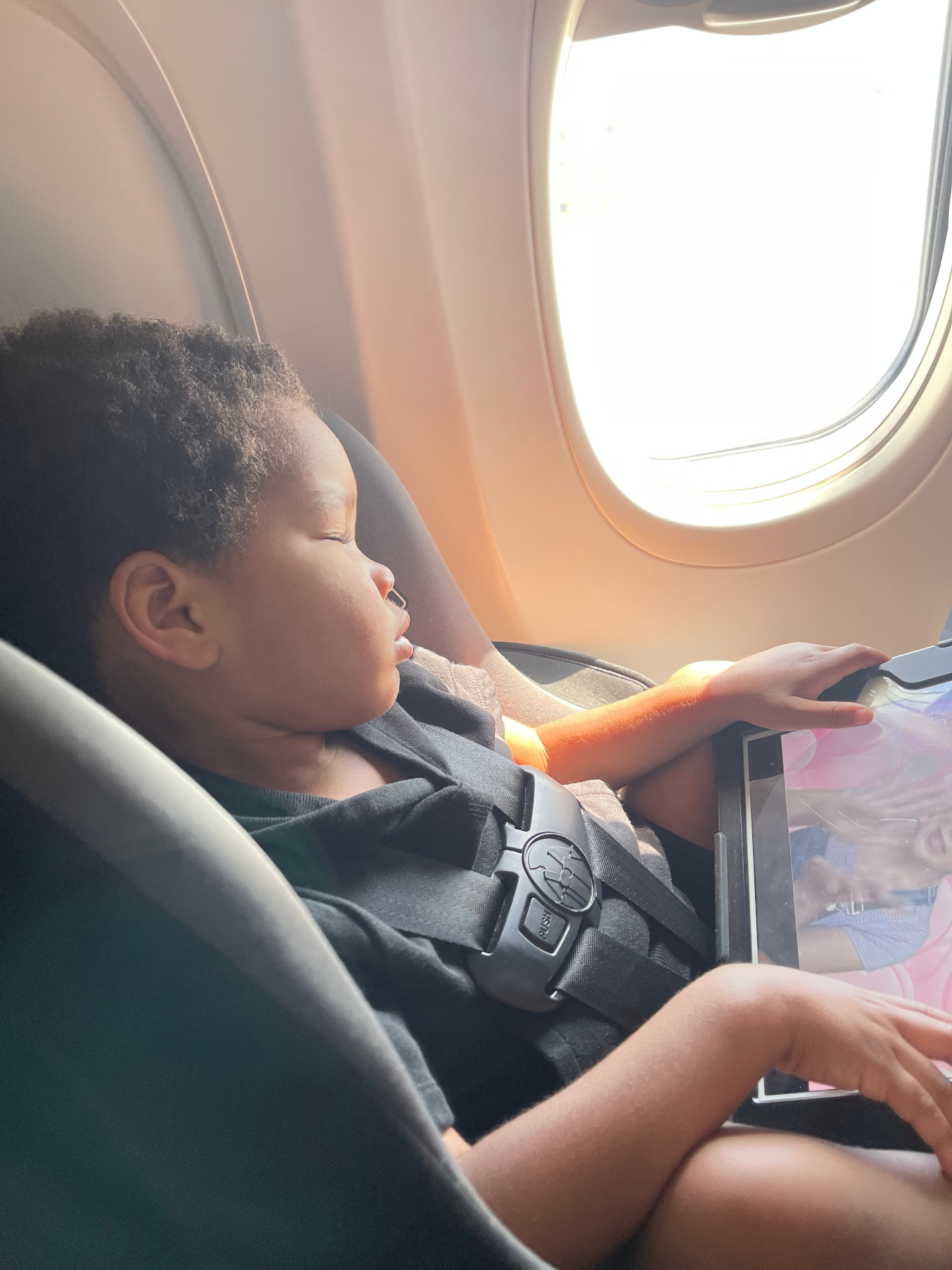
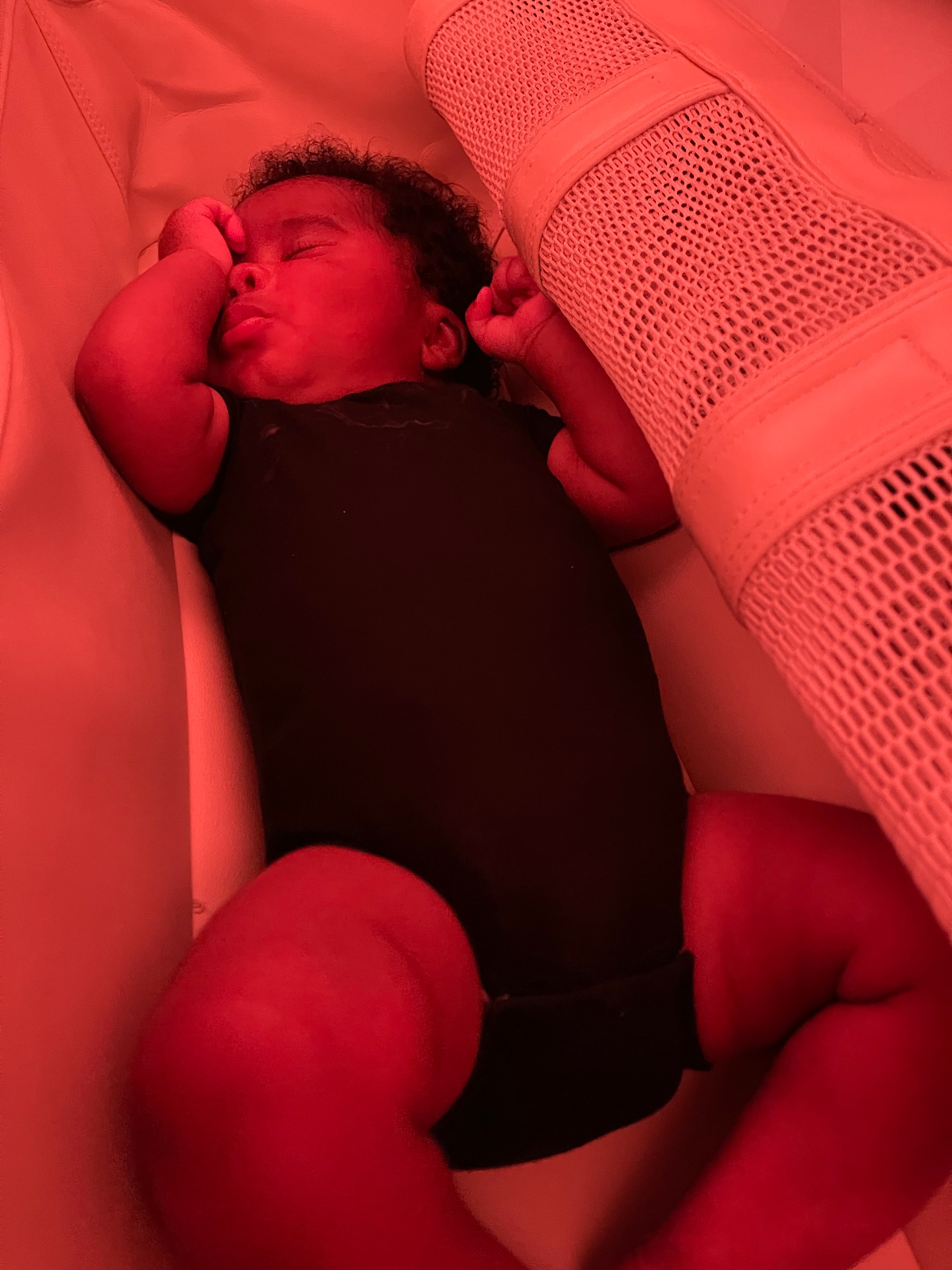
Our travel day began in Columbus at about 3:15 p.m. on Thursday, May 30. We reached Atlanta around 4:50, then boarded the 8:05 p.m. Delta flight to Venice, landing at 11:40 a.m. Friday. Preston had his own airplane seat with his car seat installed; Avery traveled as a lap infant. We had called Delta before the trip to request a bassinet and ultimately received seats in the bassinet row. The bassinet helped, but it was not a complete sleep solution — when turbulence required Avery to be removed, he slept on us. We took whatever sleep the night allowed.
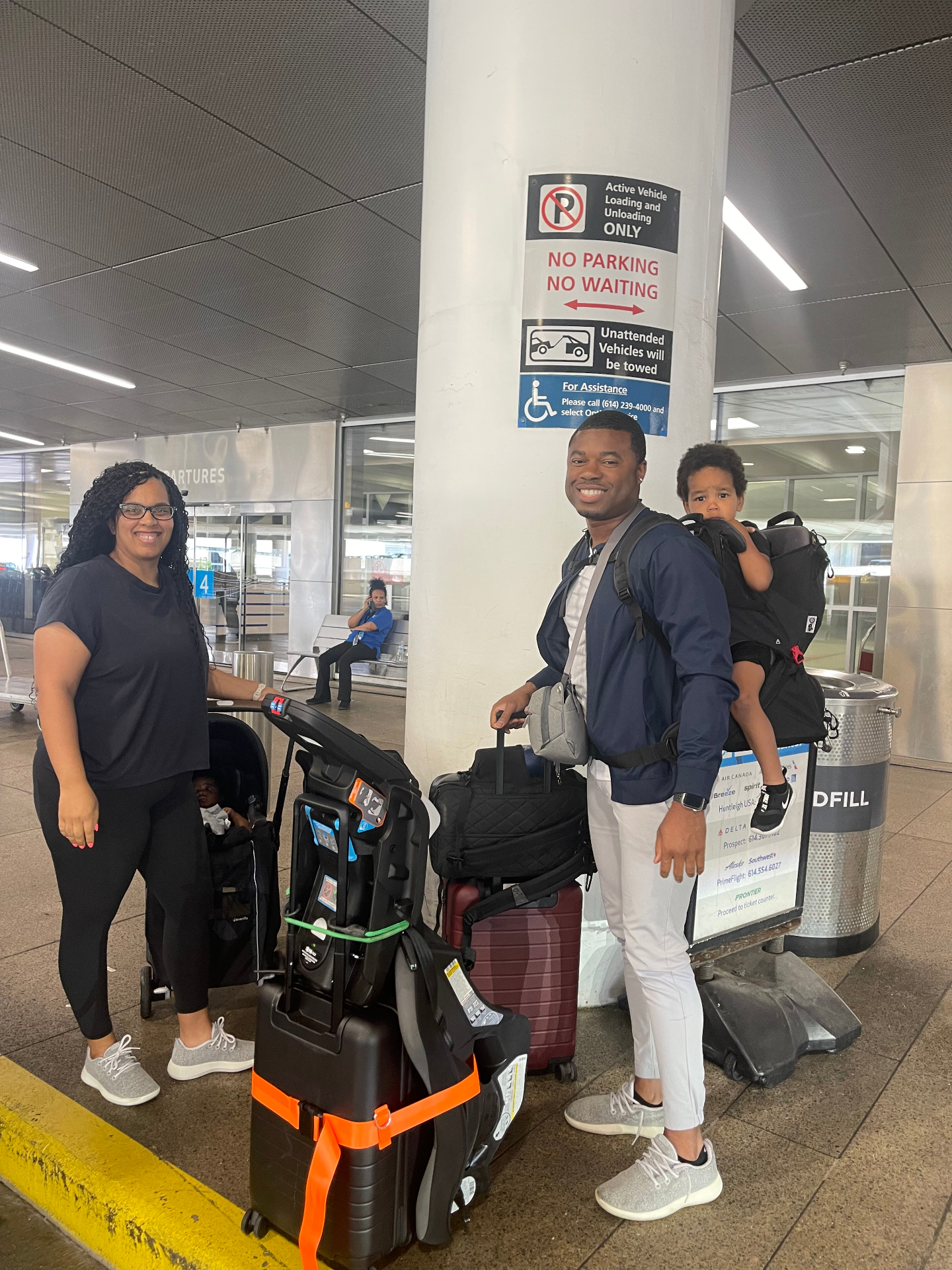
We traveled carry-on only, but that did not mean hands-free: two carry-on suitcases, our ordinary backpack, a separate backpack dedicated to pumping, the hiking carrier, the stroller system with Avery's infant car seat and Preston's car seat.
The Additional Work of Exclusively Pumping
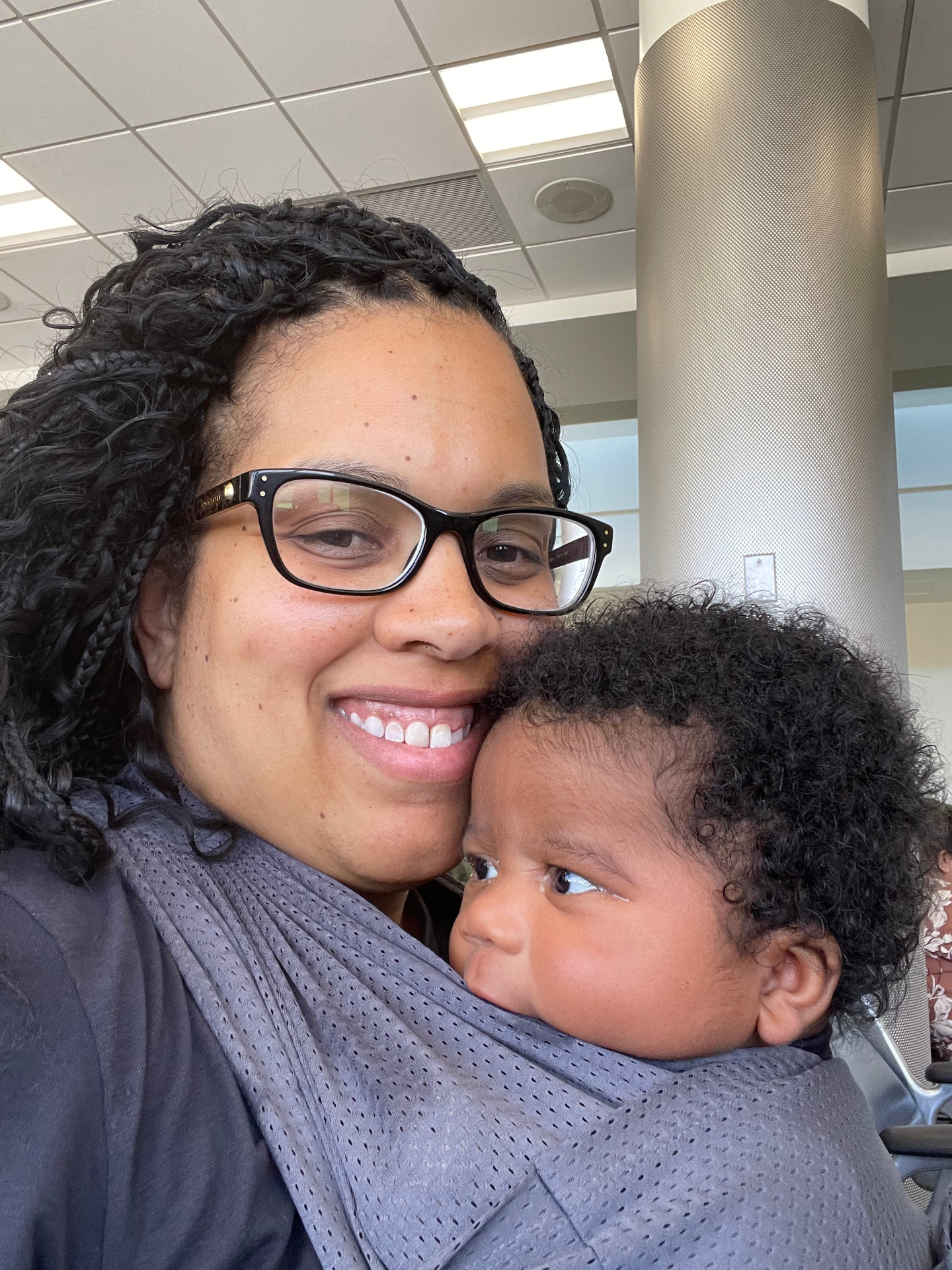
The most difficult part of the flight was not convincing the boys to sleep. It was maintaining an exclusively pumping routine across a long travel day. The dedicated backpack held the Spectra Gold pump I used at home, the Elvie Stride, multiple sets of parts, bottles, a brush, familiar soap and cleaning supplies. I also traveled with the Ceres Chill milk-storage system and ice packs to protect the milk I produced in transit. At the airport, I could not locate a pumping room, so I found a quiet corner; on the overnight flight, I pumped from my seat. Neither setting was ideal. Both were part of getting our family where we wanted to go.
Travel with an infant often appears effortless in photographs because the baby is asleep. The photograph cannot show the equipment, timing, washing, storage and planning happening outside the frame.
Arriving in Venice by Water
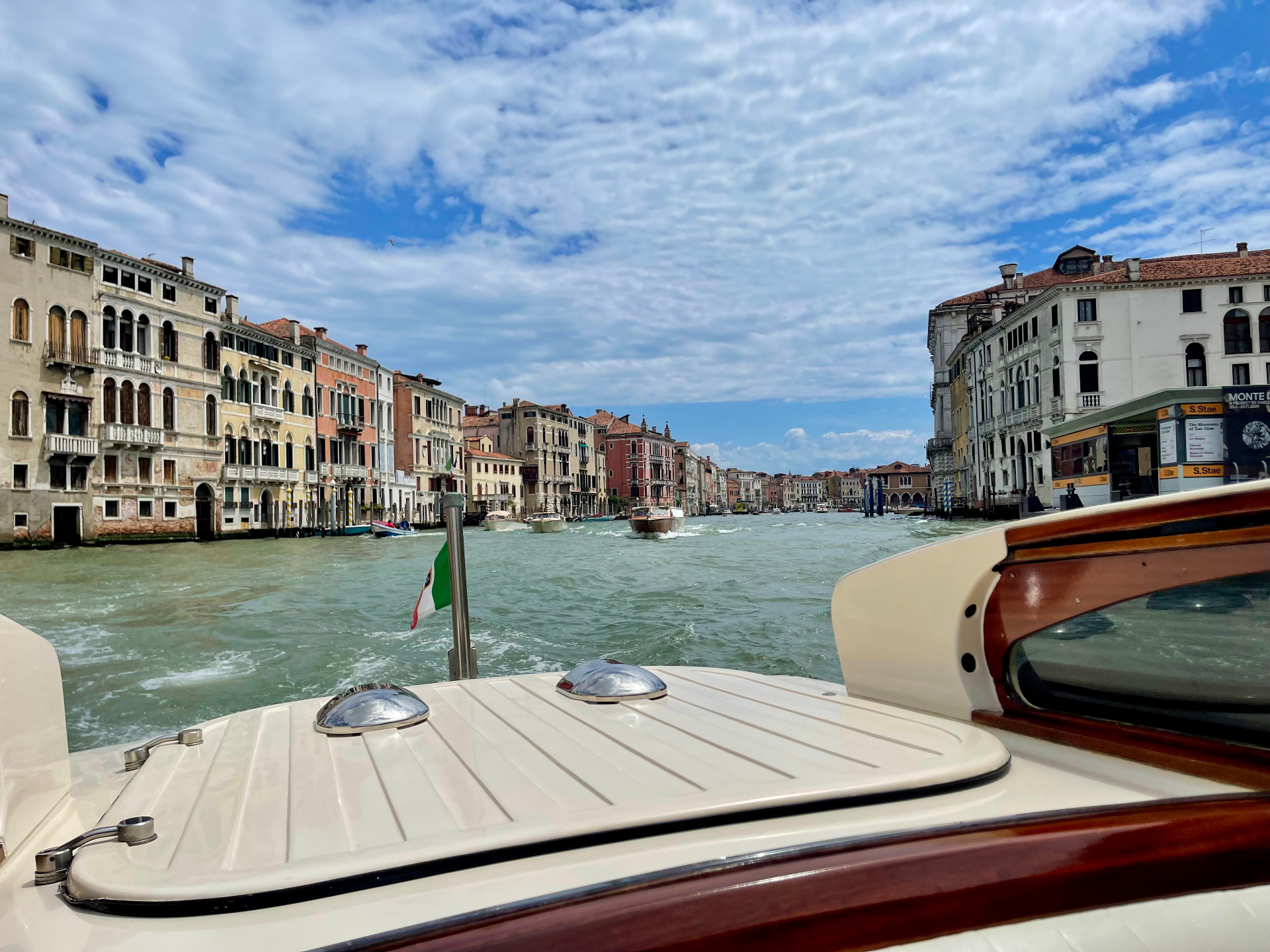
After customs at Marco Polo Airport, we still had a meaningful walk ahead. The water-taxi dock was farther from the terminal than we expected while pushing a stroller and managing car seats, carriers, backpacks and suitcases. Our Airbnb host had made the decision easier before we arrived, recommending Consorzio Motoscafi Venezia for a private water taxi. We reserved the transfer in April and provided the apartment information so the company could select the closest accessible dock; our 2024 booking was €140.
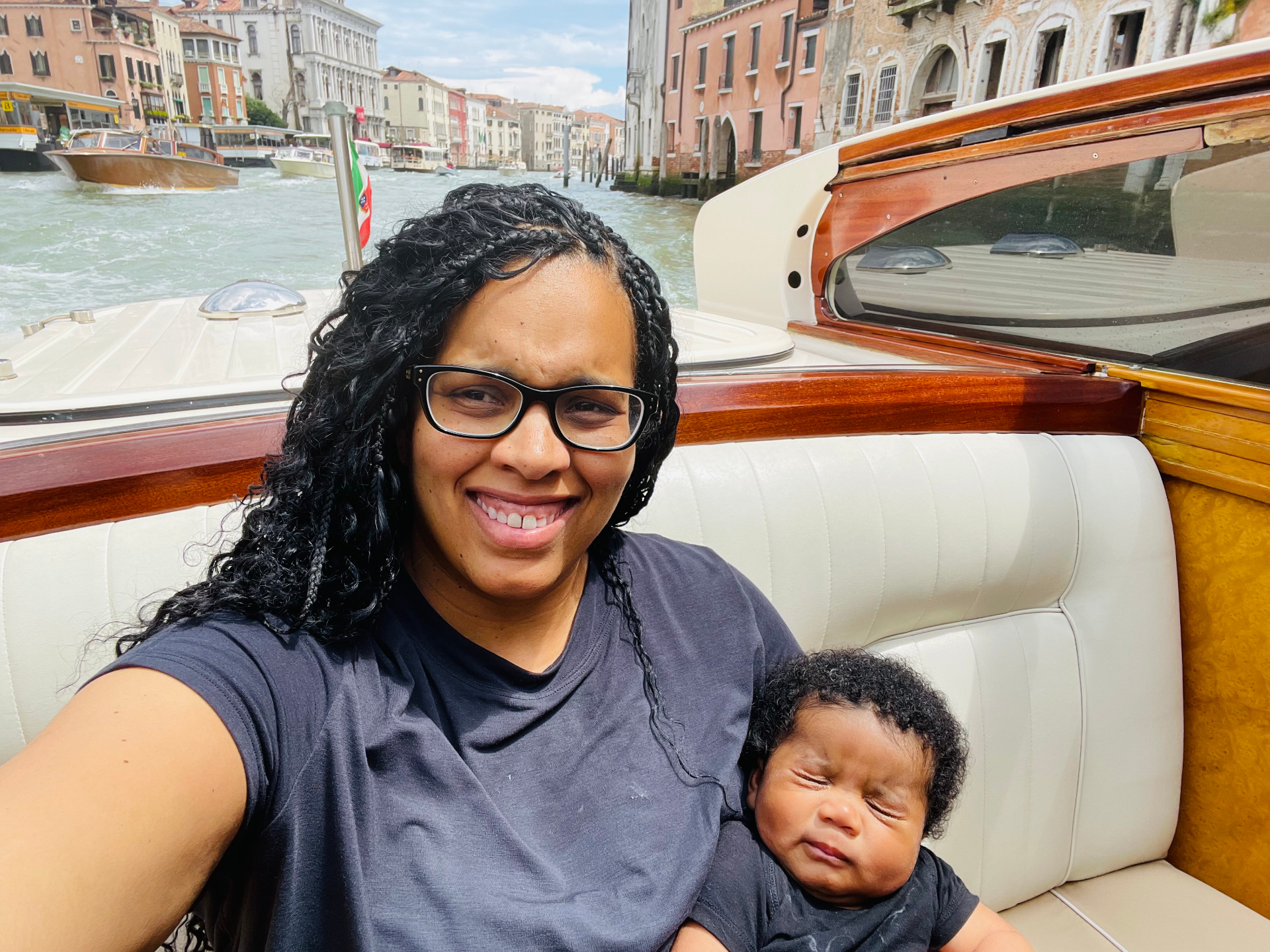
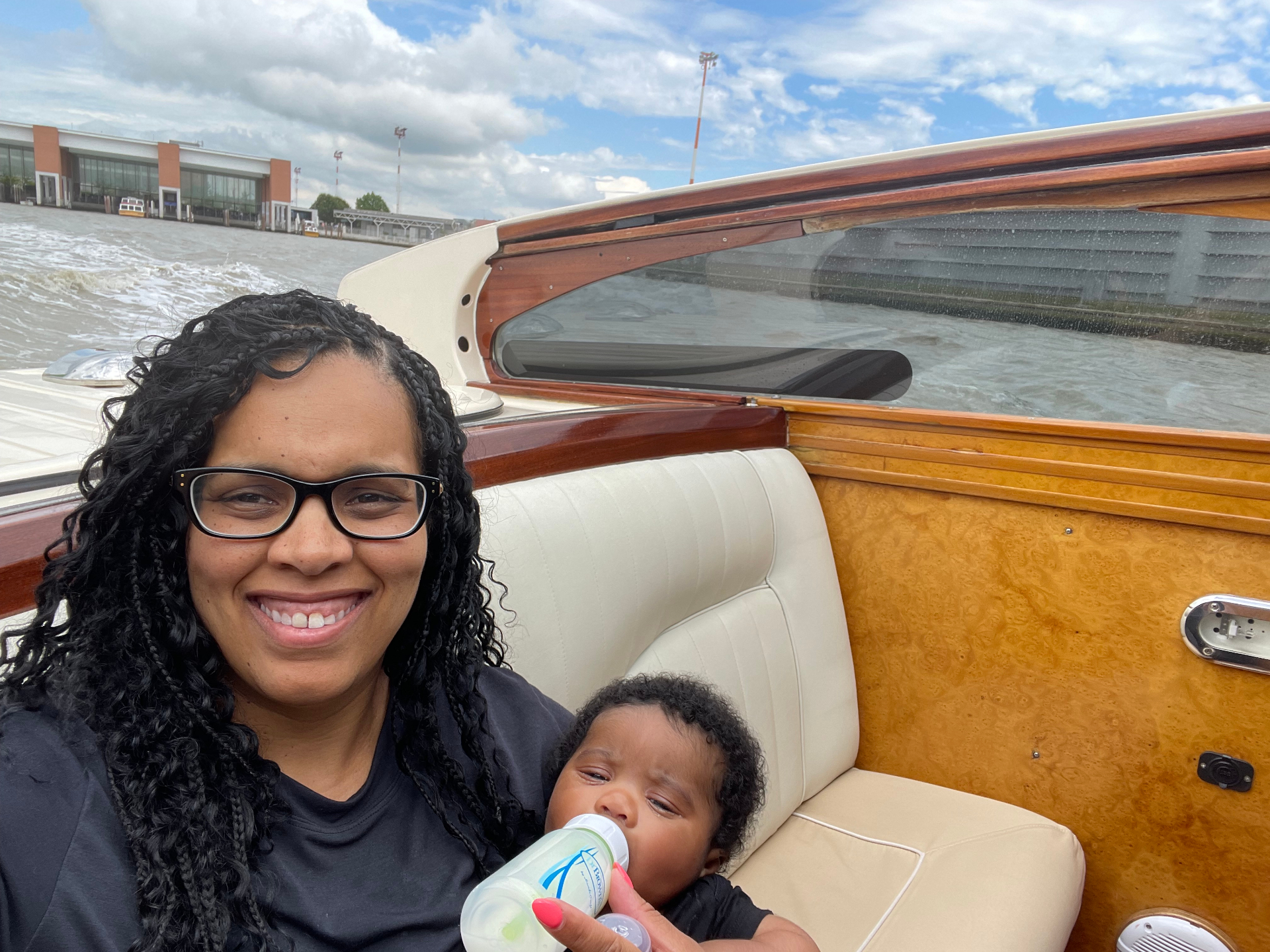
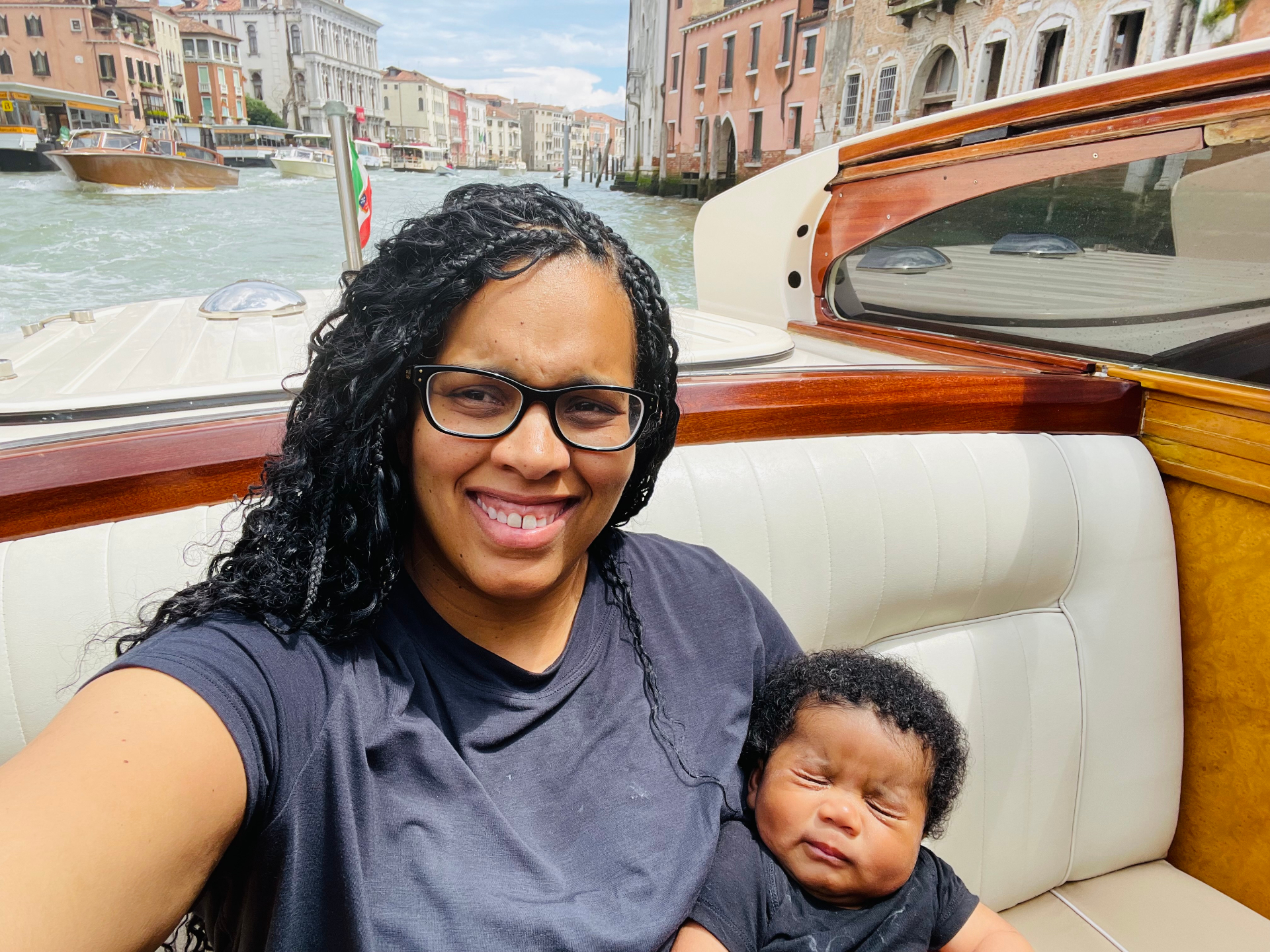
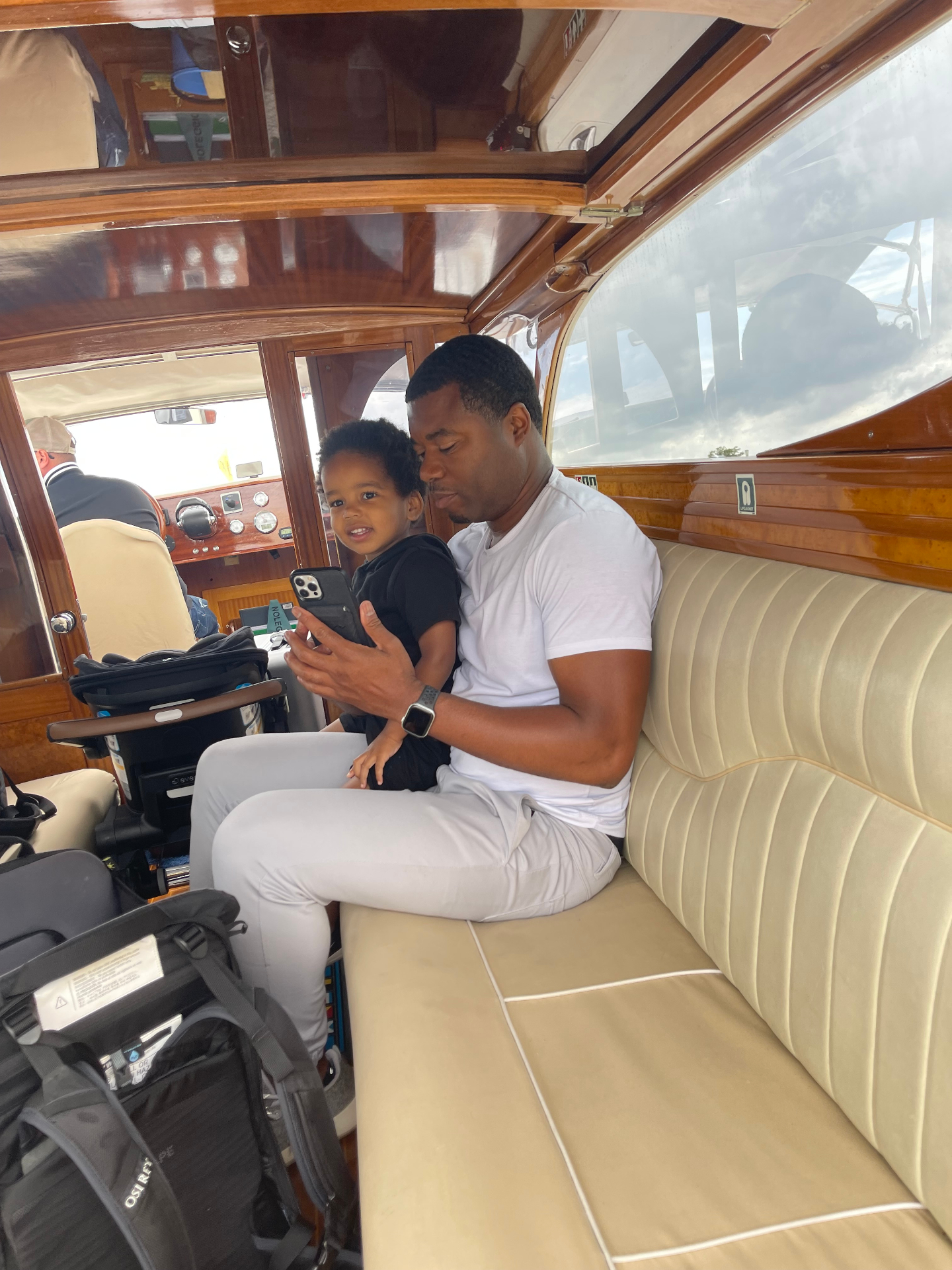
The boat included a covered interior and an open area at the back. Once we pulled away from the airport, the transfer became one of the coolest travel experiences we have ever had.
When else do you leave an airport by boat and enter a city from the water?
The ride gave us an introduction to Venice before we had crossed a bridge or found a landmark. We could watch the city approach and understand that boats were not a novelty but the transportation system. A gondola ride might have been more iconic — the water taxi was practical, memorable and impossible for the boys to derail, because we needed the ride either way.
Making Campo San Polo Our Home Base
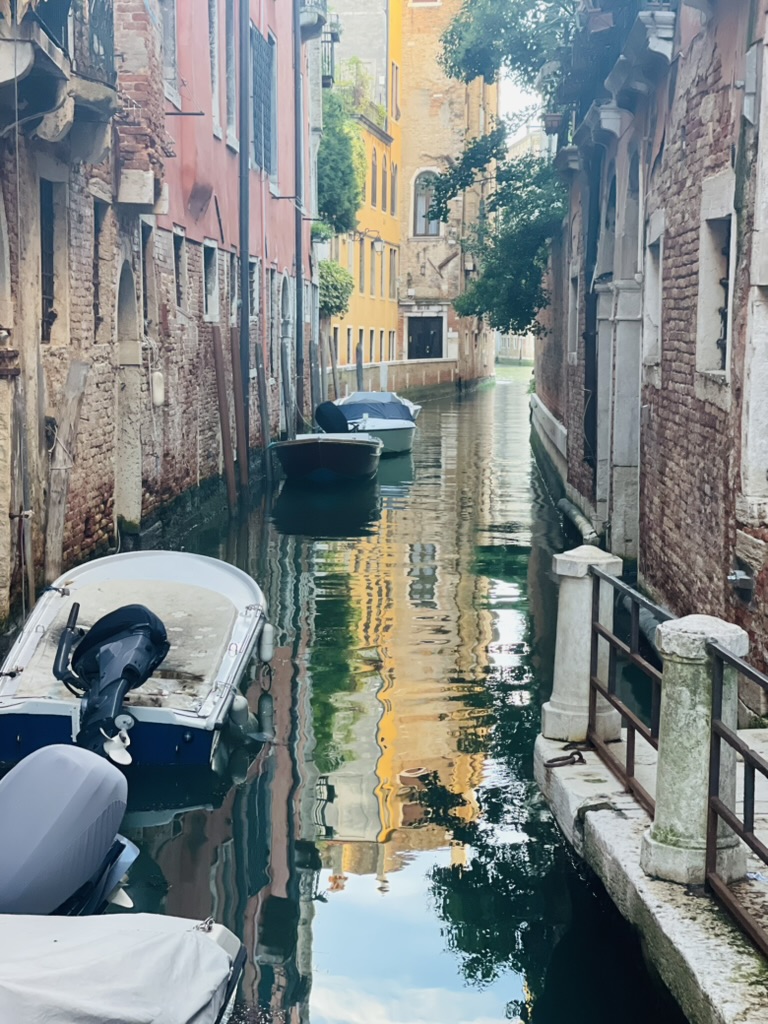
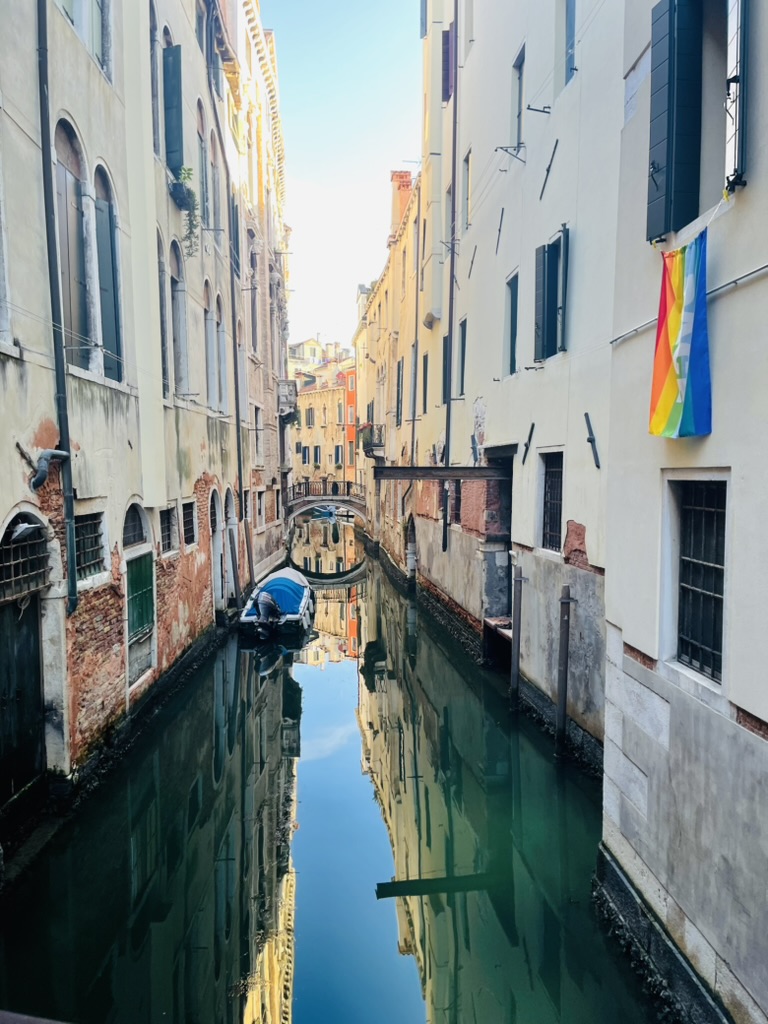
We stayed in an Airbnb listed as Cozy Two Rooms Apartment Near the Rialto Bridge, just off Campo San Polo. The private water taxi brought us as close as the canals allowed, and from the dock we oriented ourselves with the host's directions. Because the apartment was not yet ready, we left our bags in a building storage area for about an hour and ate at a nearby restaurant the host recommended. The location became one of the strongest decisions of the stay — Campo San Polo felt quiet enough to return to, while the Rialto Bridge, Grand Canal and the places we wanted to see stayed within walking distance.
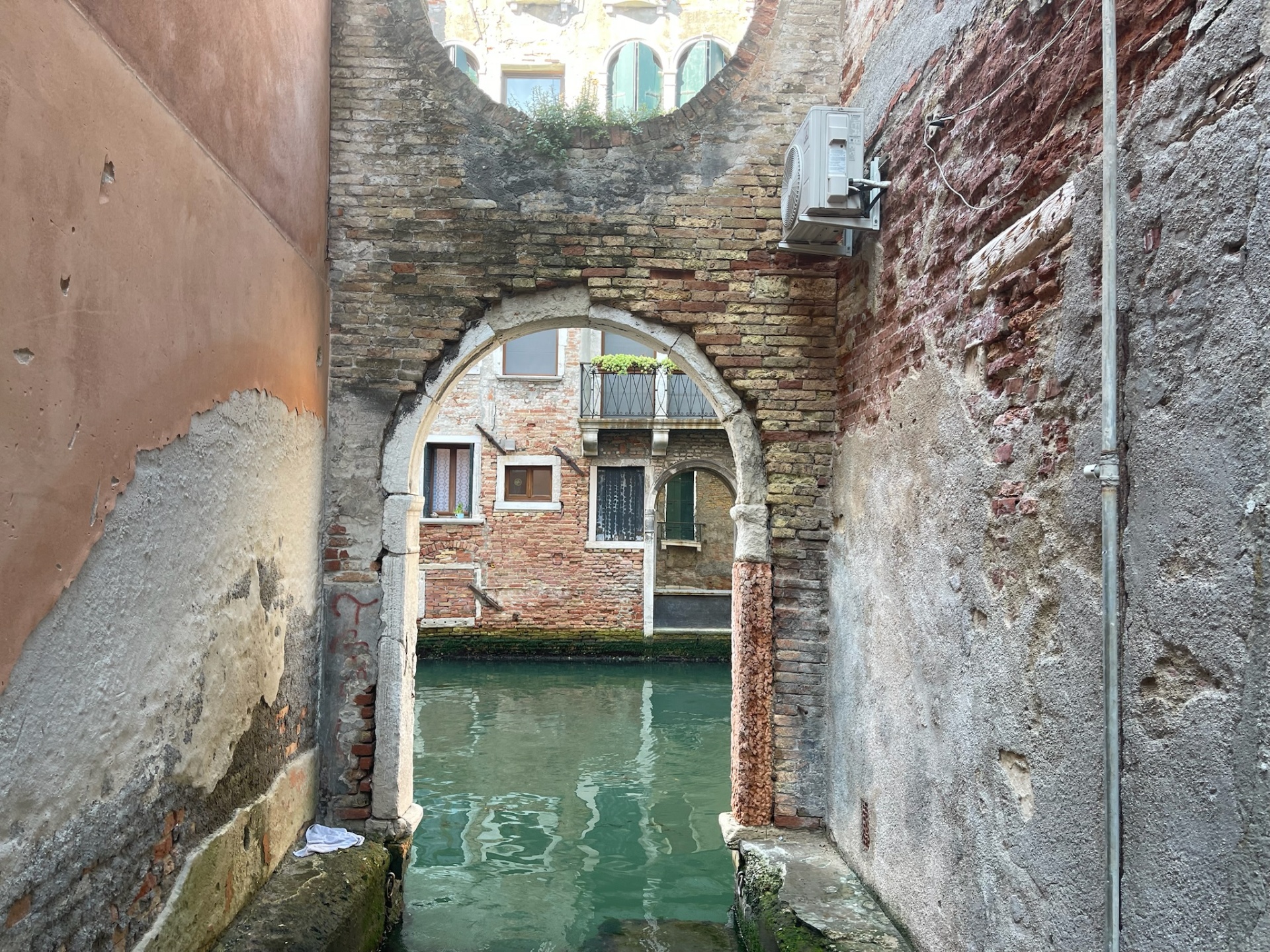
Inside the Apartment
The apartment had two bedrooms, a kitchen with a refrigerator and freezer — essential for storing milk and ice packs — and a small common area. There was no elevator, and the apartment sat several floors above street level, so every departure and return required stairs. Families traveling with larger luggage or anyone with mobility concerns should understand building accessibility before booking in Europe. The host provided a pack-and-play for an additional fee; it was the only dedicated baby equipment available.
Keeping the Home Sleep Arrangement
We divided the bedrooms — one adult and one kid in each room. Preston slept in my room; Avery slept in Kyle's. The arrangement let me wake and pump without repeatedly interrupting Kyle, and let Kyle handle Avery's overnight bottles without waking me. Sometimes the most useful accommodation is one that lets the family reproduce the rhythm already keeping everyone functional at home.
The Rialto Bridge and Grand Canal
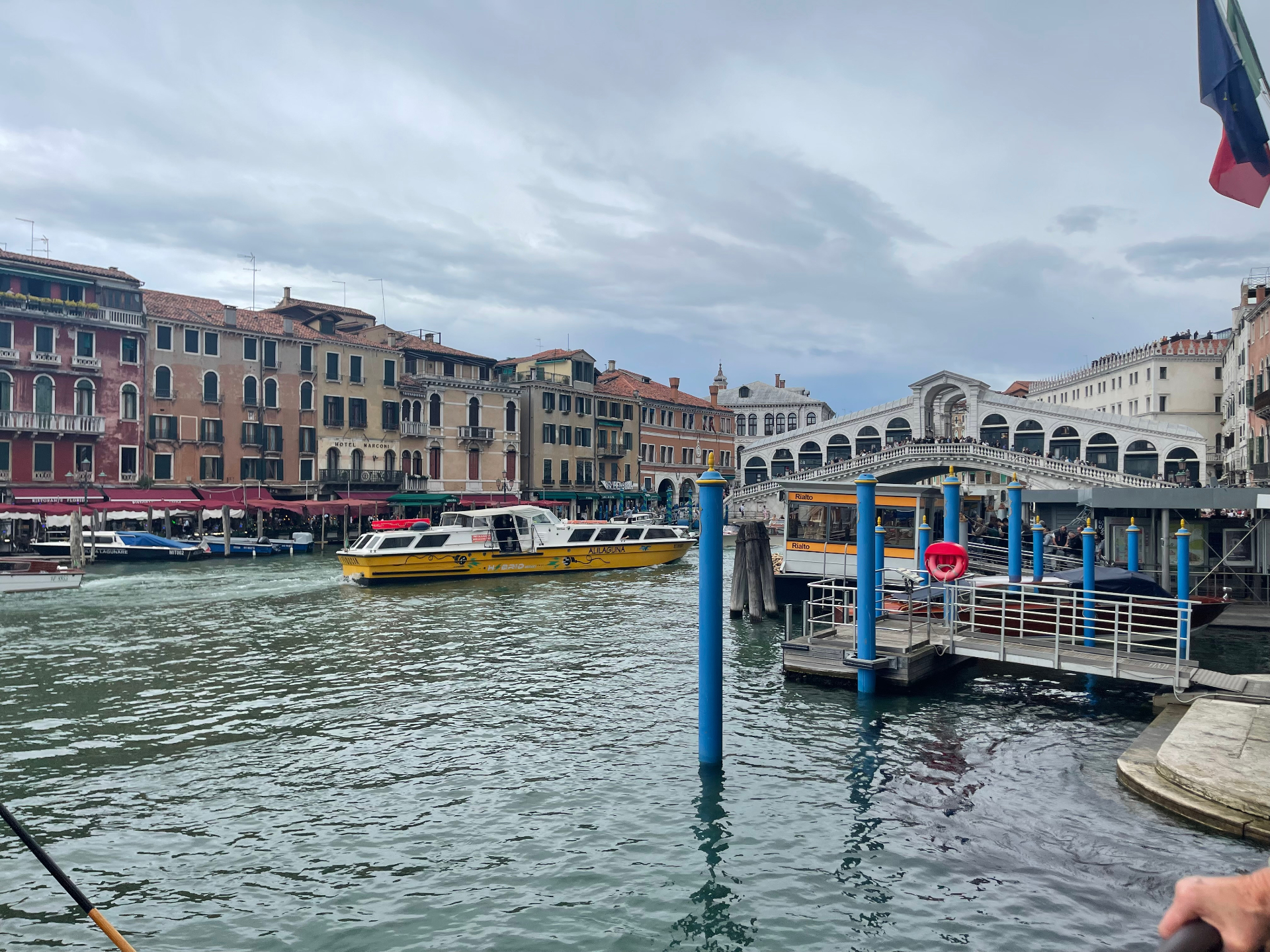
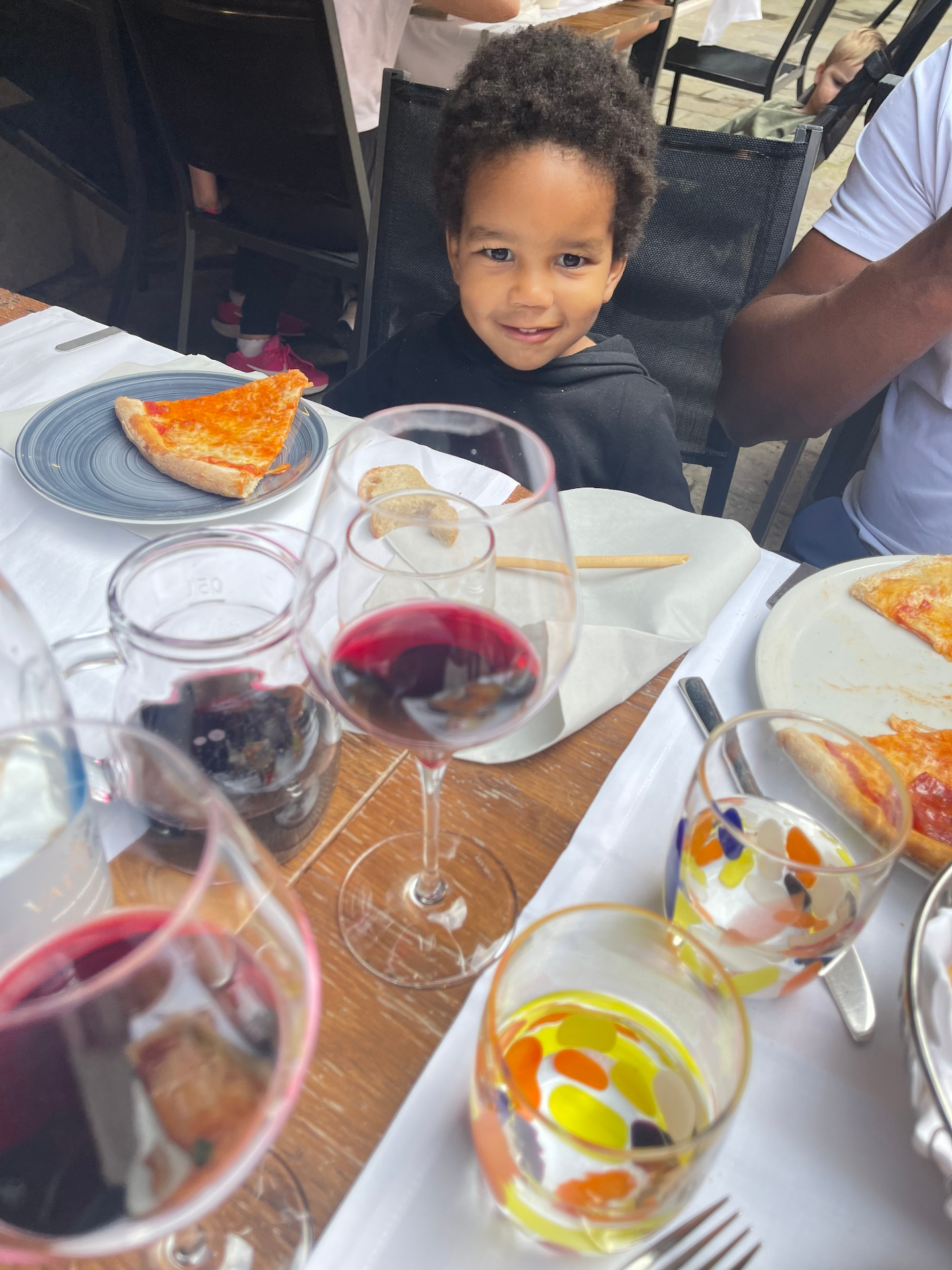
While we waited for check-in, we ate at Trattoria Al Campanile near Campo San Polo — pizza and wine, uncomplicated and exactly enough after the overnight flight. Once we settled in, we walked toward the Rialto Bridge and Grand Canal, moving without a formal itinerary and letting the city reveal itself at walking pace.
The reaction was simply: wow.
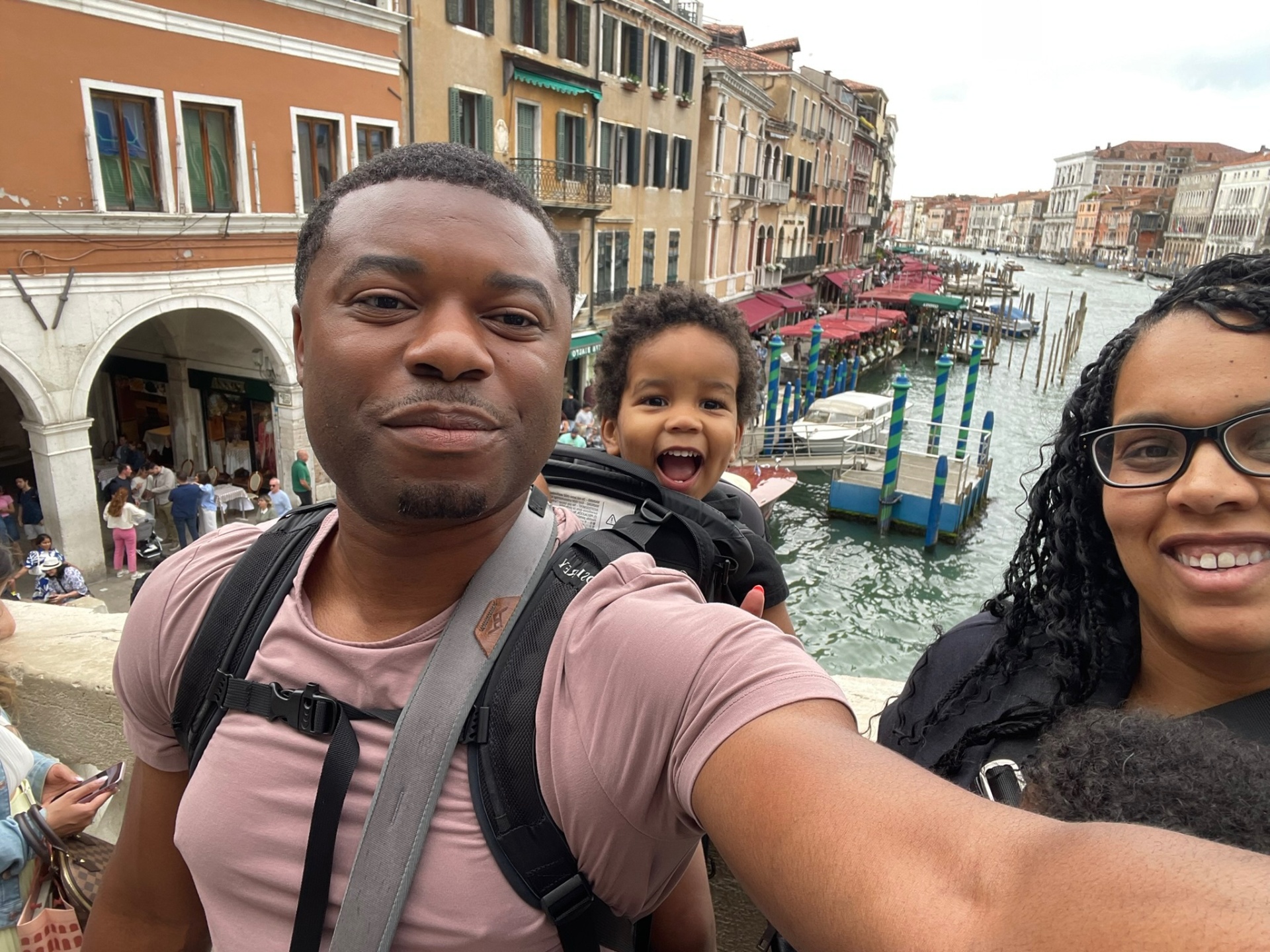
The Grand Canal was not only beautiful. It was evidence that the entire city operated according to a system our eyes had never seen in the United States. There were no cars waiting around the corner. Boats moved people and supplies. Water did the work a roadway would do at home. A still image can show a bridge, façade or gondola — it cannot fully communicate what it feels like to stand inside a city where the absence of vehicles changes the sound, movement and logic of daily life. We stopped at a small gelato stand in Campo San Polo more than once. We do not remember its name; we remember the pleasure of having it just outside our temporary home.
Before Venice Woke Up
I wake early on many of our trips; in Venice, jet lag and the pumping schedule made it almost inevitable. On our only full day, I finished pumping and could not go back to sleep. Rather than wake everyone, I left the apartment and walked into the city alone around 6:30 a.m. By 7:30, I was back and both boys were still asleep.
If your body wakes you early in Venice, consider it an invitation.
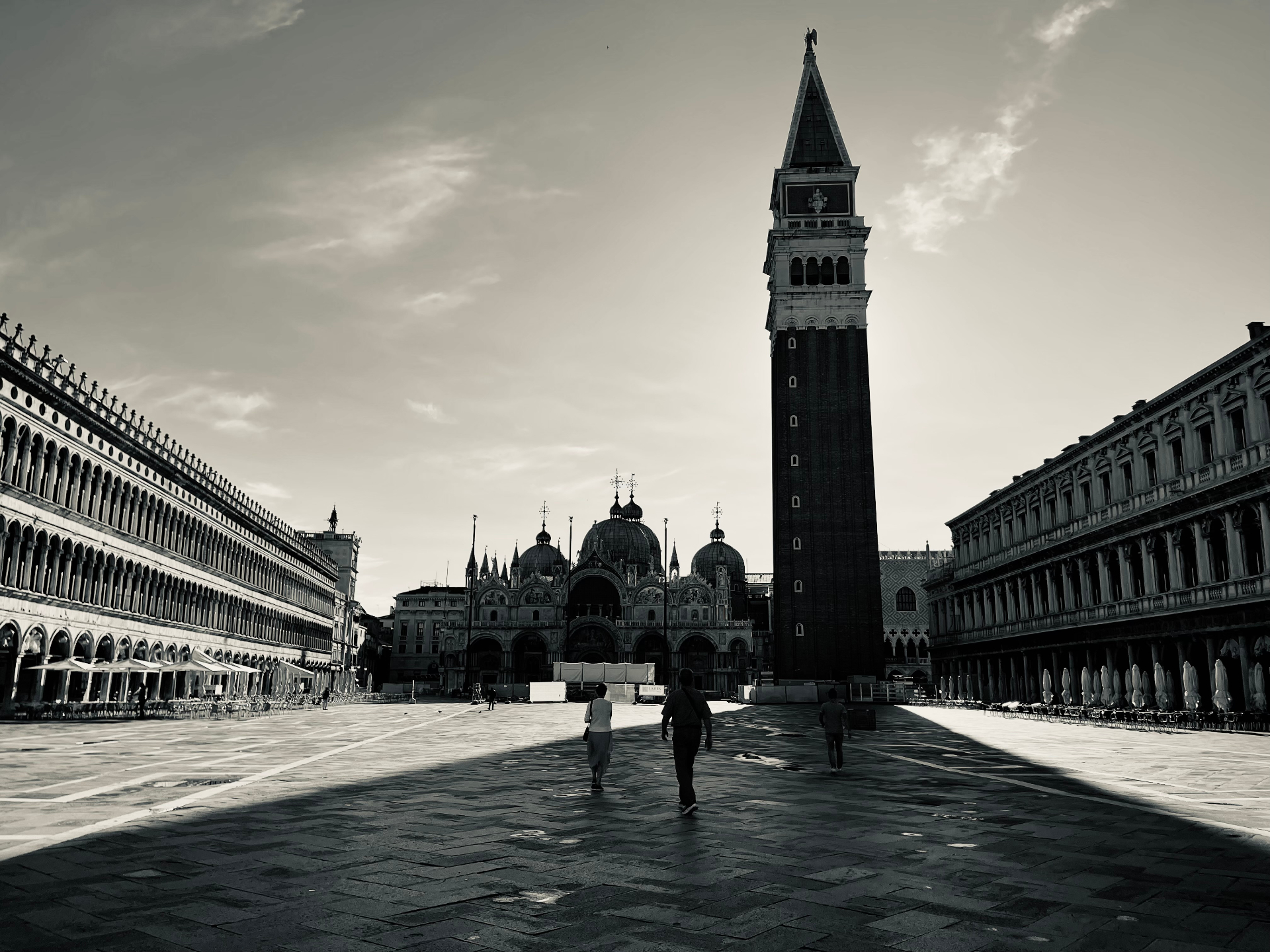
In that hour, I found coffee near the Rialto Bridge, returned to the Grand Canal and continued toward St. Mark's Square and the Doge's Palace. I did not enter a building — I wandered, looked and let the quiet become the experience. Famous spaces that ordinarily hold crowds had room to breathe. I felt comfortable walking alone, remaining alert and using Apple Maps through my Apple Watch, which vibrated when I needed to turn so I could navigate without walking with my phone in my hand. This early hour has become one of my favorite travel rituals — a reset before the practical work of moving a family through the day begins.
Cannaregio, Puddles and the Boat to Burano
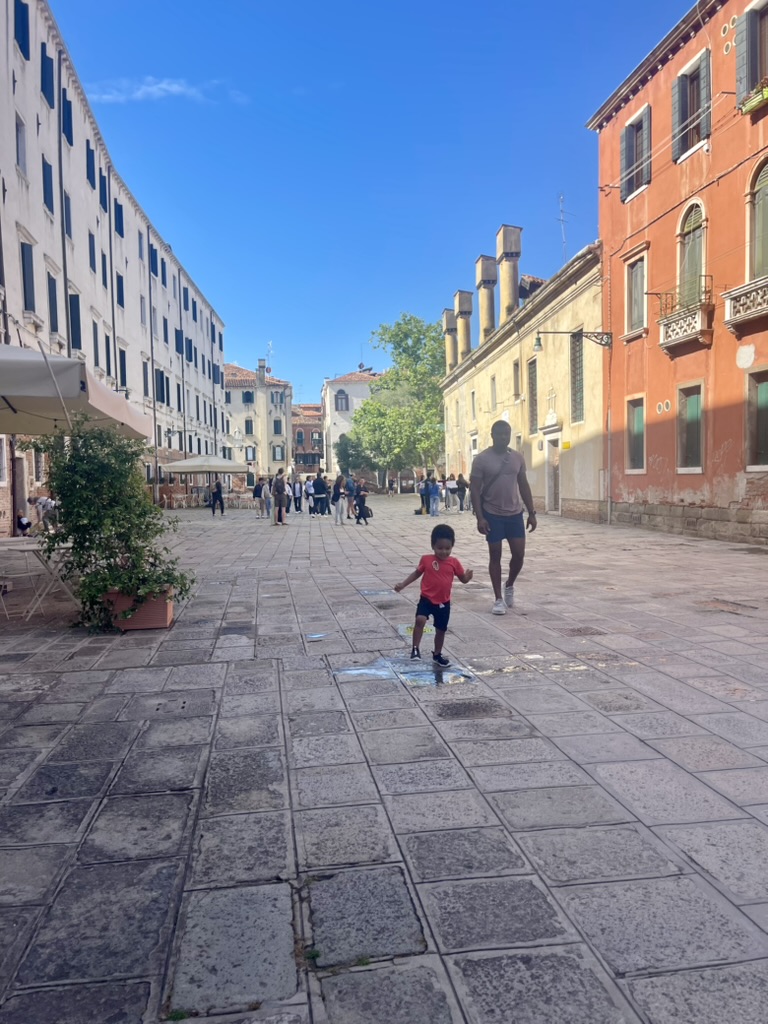
Once everyone was awake, we walked toward Cannaregio to reach the vaporetto to Burano. Along the way, we found an impromptu concert in a neighborhood square. The adults were interested in the music; Preston found something better — puddles. He jumped through them with complete commitment, turning an ordinary square into one of his own Venice experiences. Children do not need to value the same part of a place that brought the adults there.
Taking Line 12
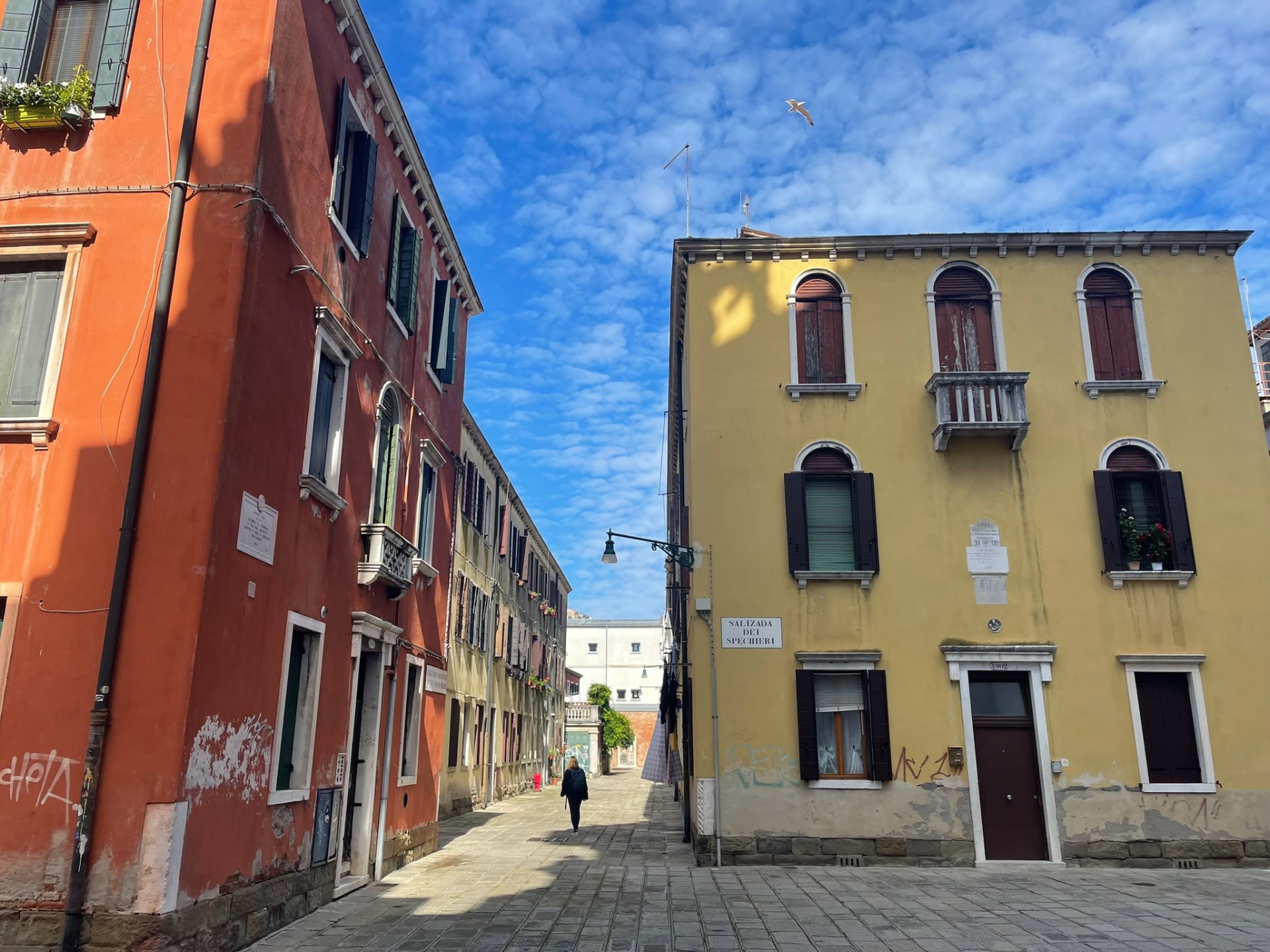
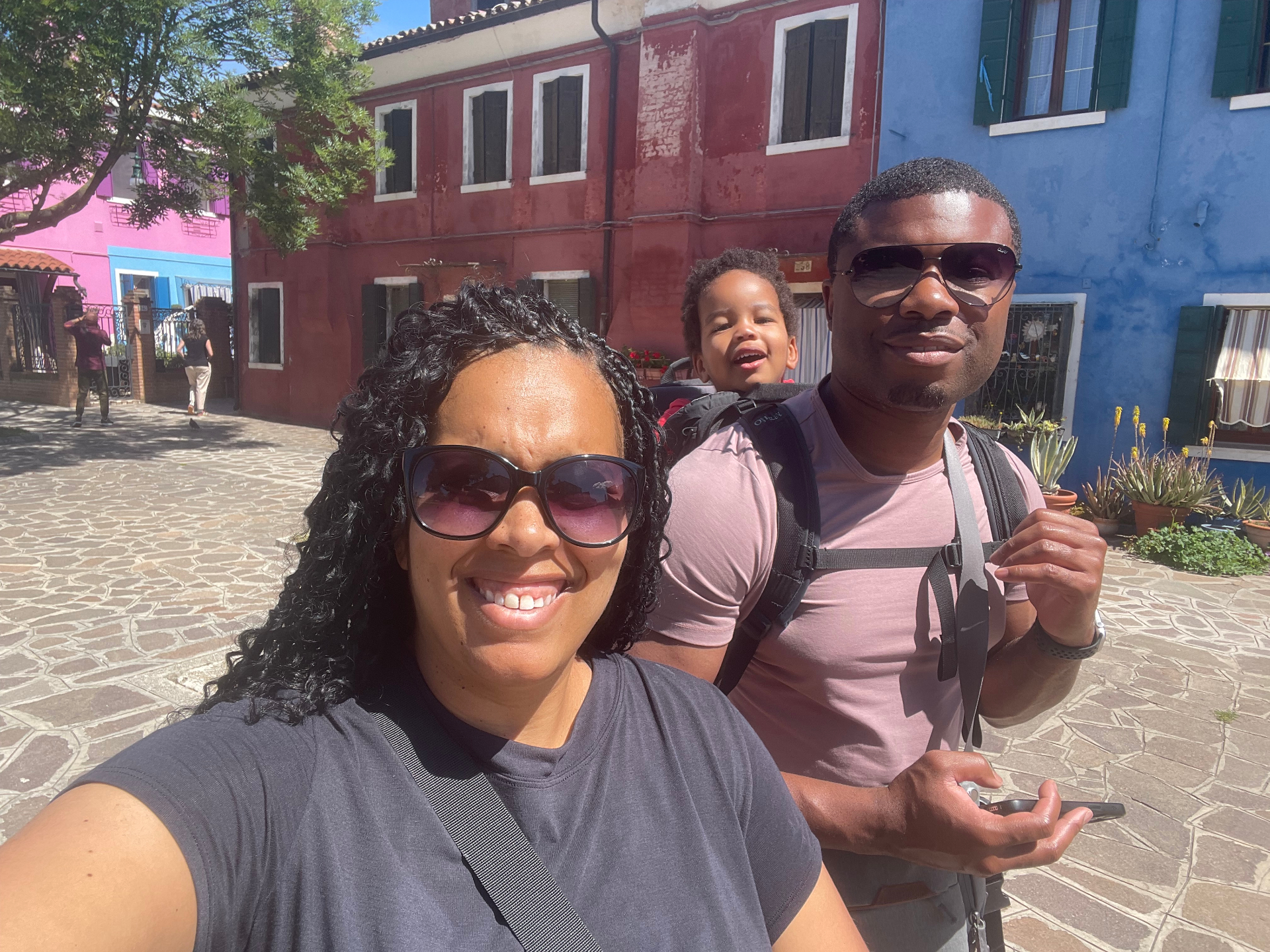
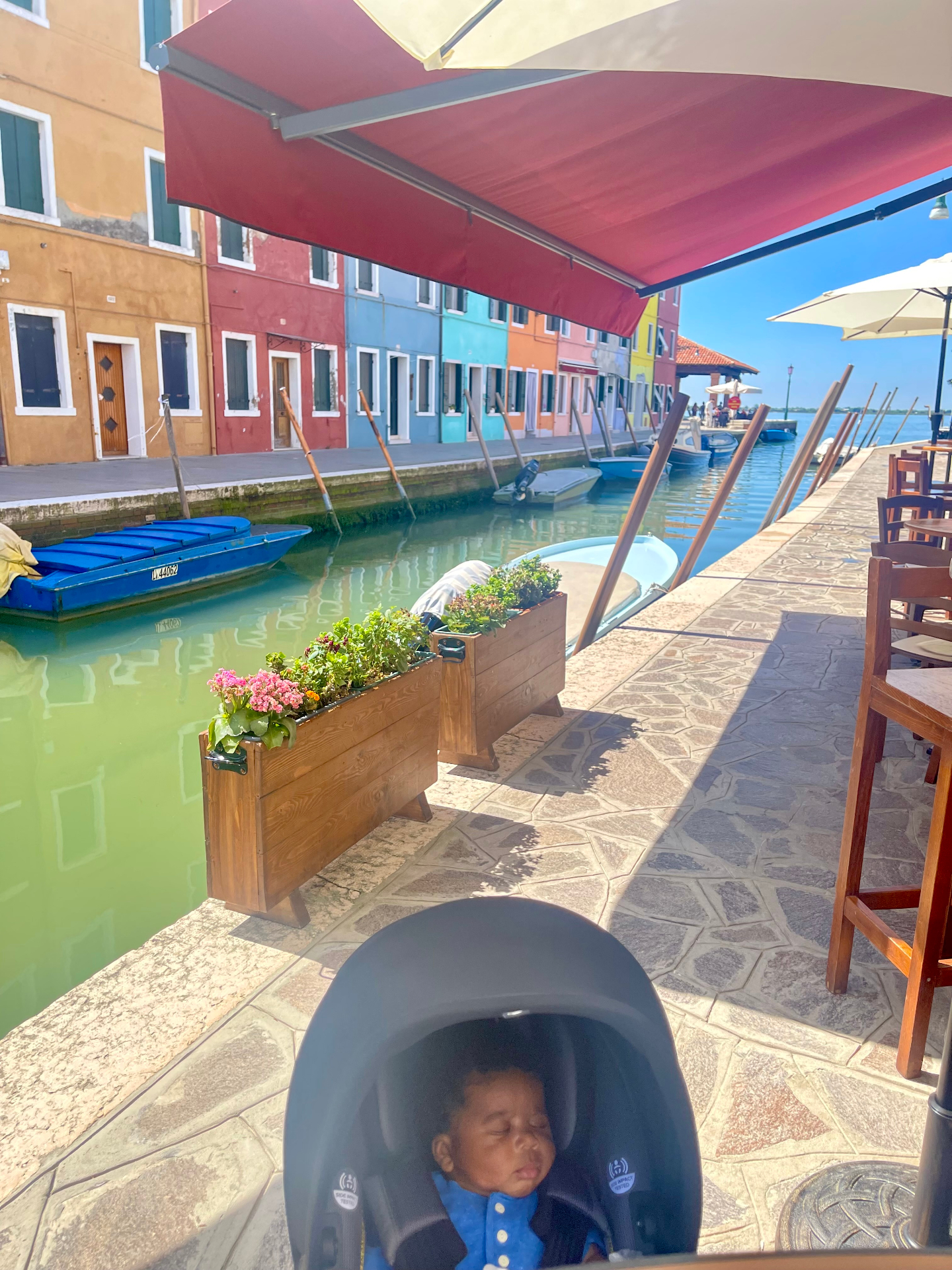
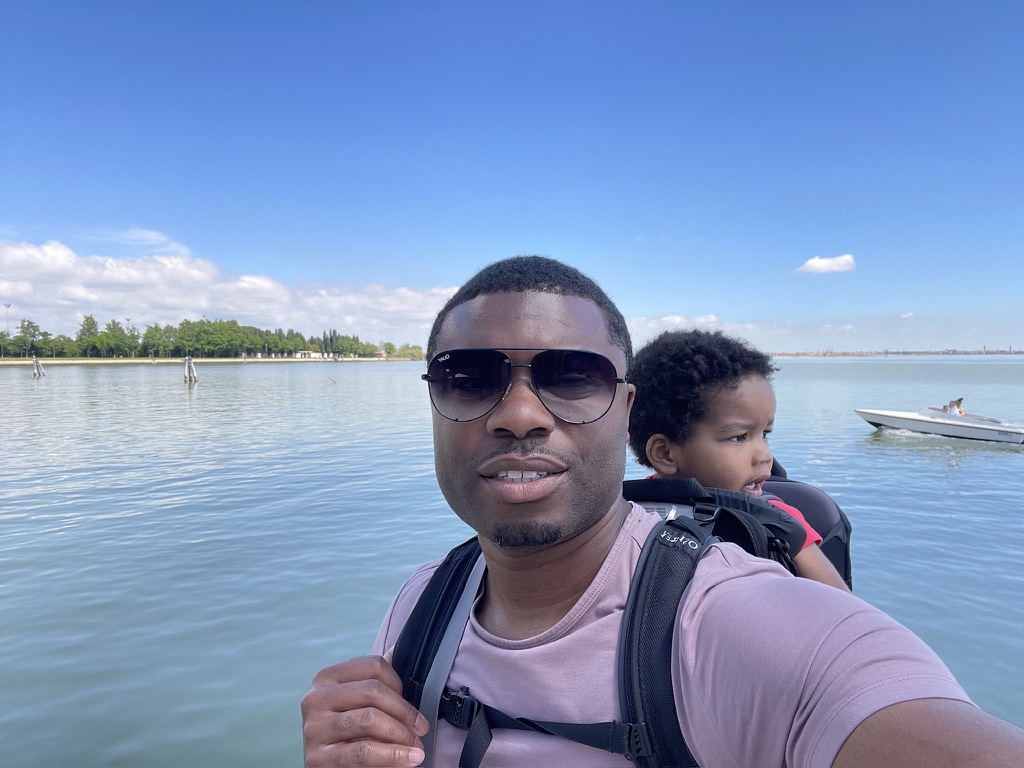
We purchased ACTV tickets that day rather than in advance. The ride took about 35 to 40 minutes and stopped at Murano before continuing to Burano. Avery slept during the journey; Preston rode comfortably in the hiking carrier on Kyle's back. The boat was transportation, but it was also another way to experience the lagoon — by the time we reached Burano, we had seen Venice from a private water taxi and from the public system connecting the islands.
Why Burano Fit Us
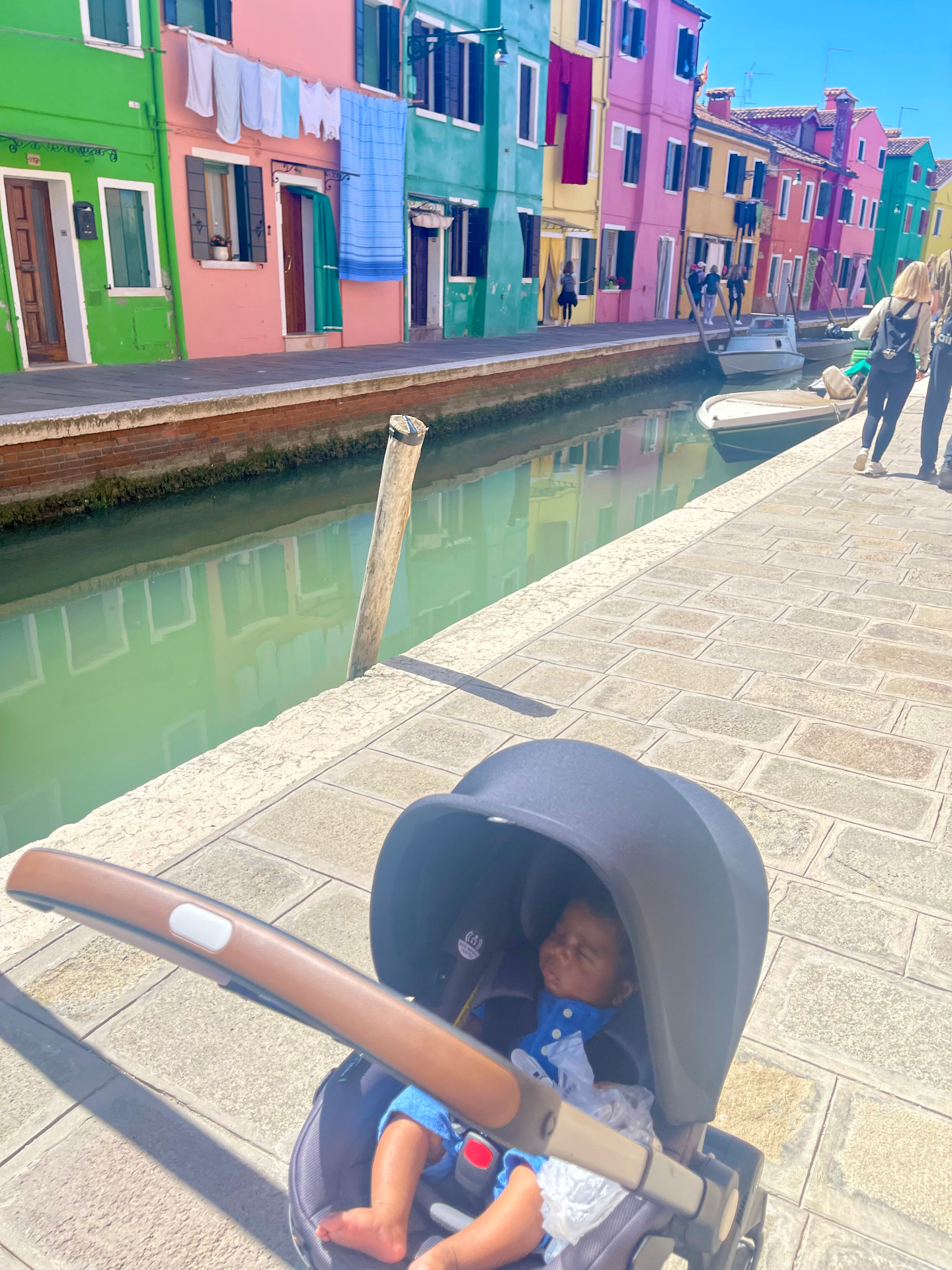
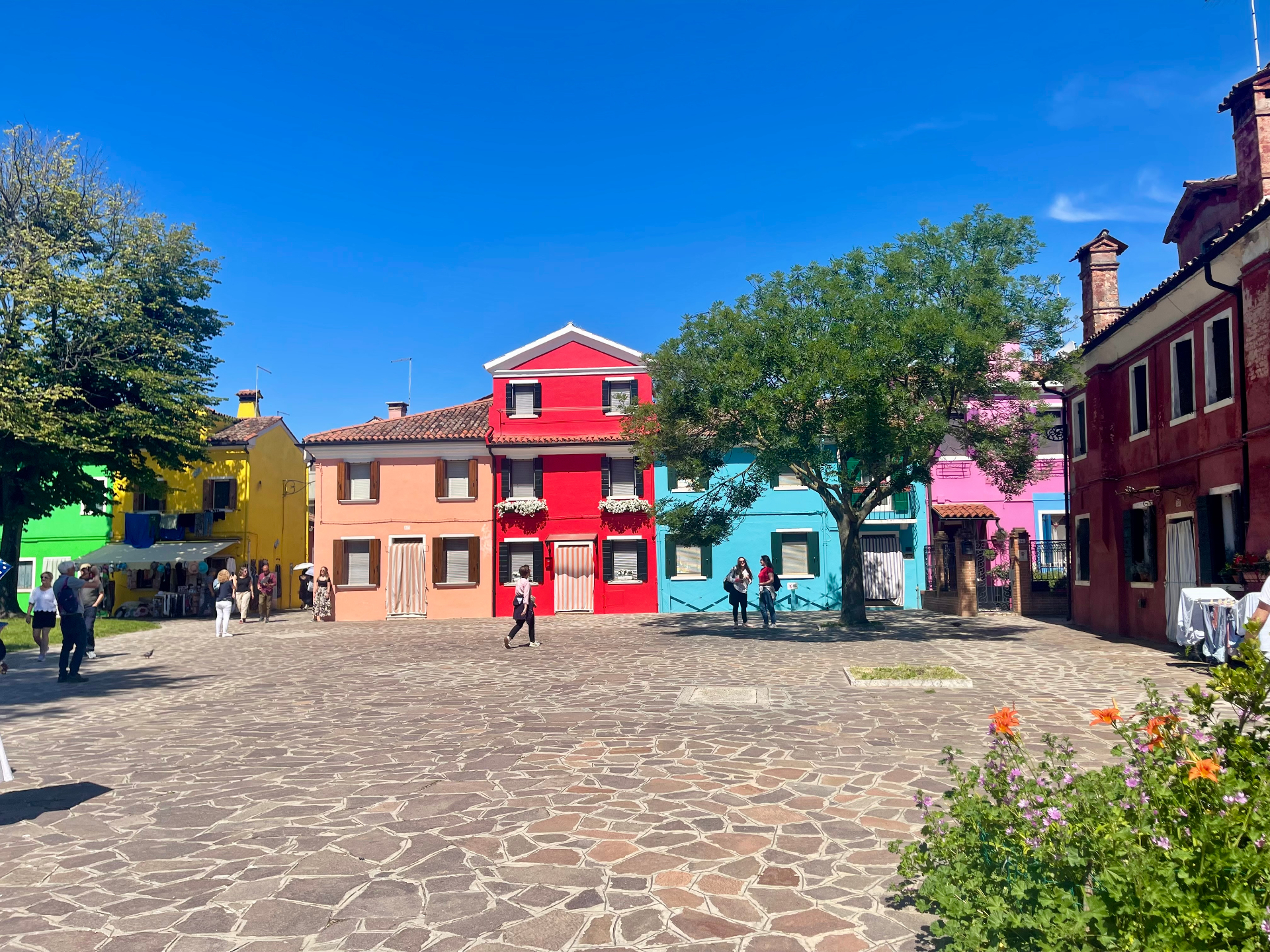
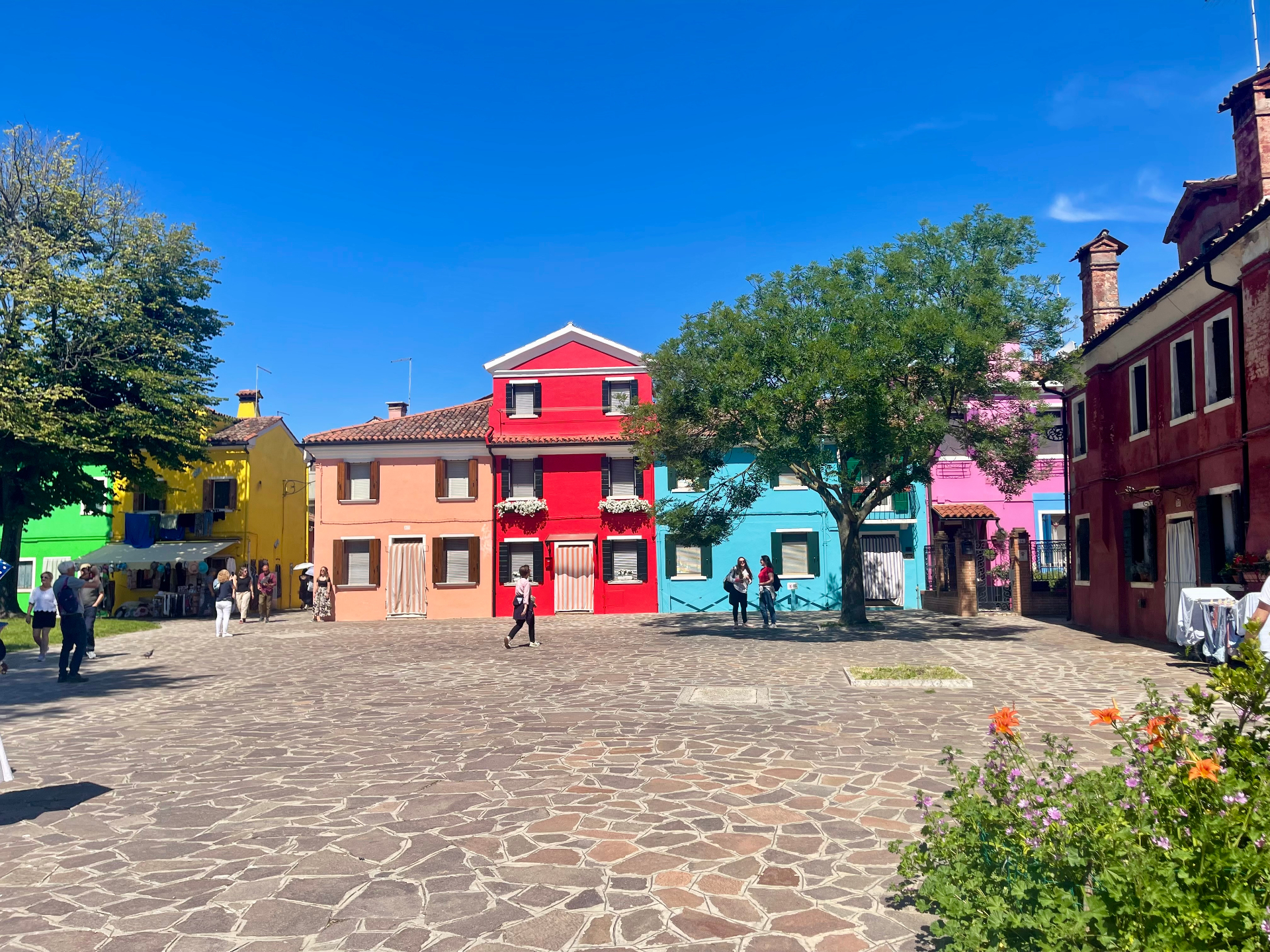
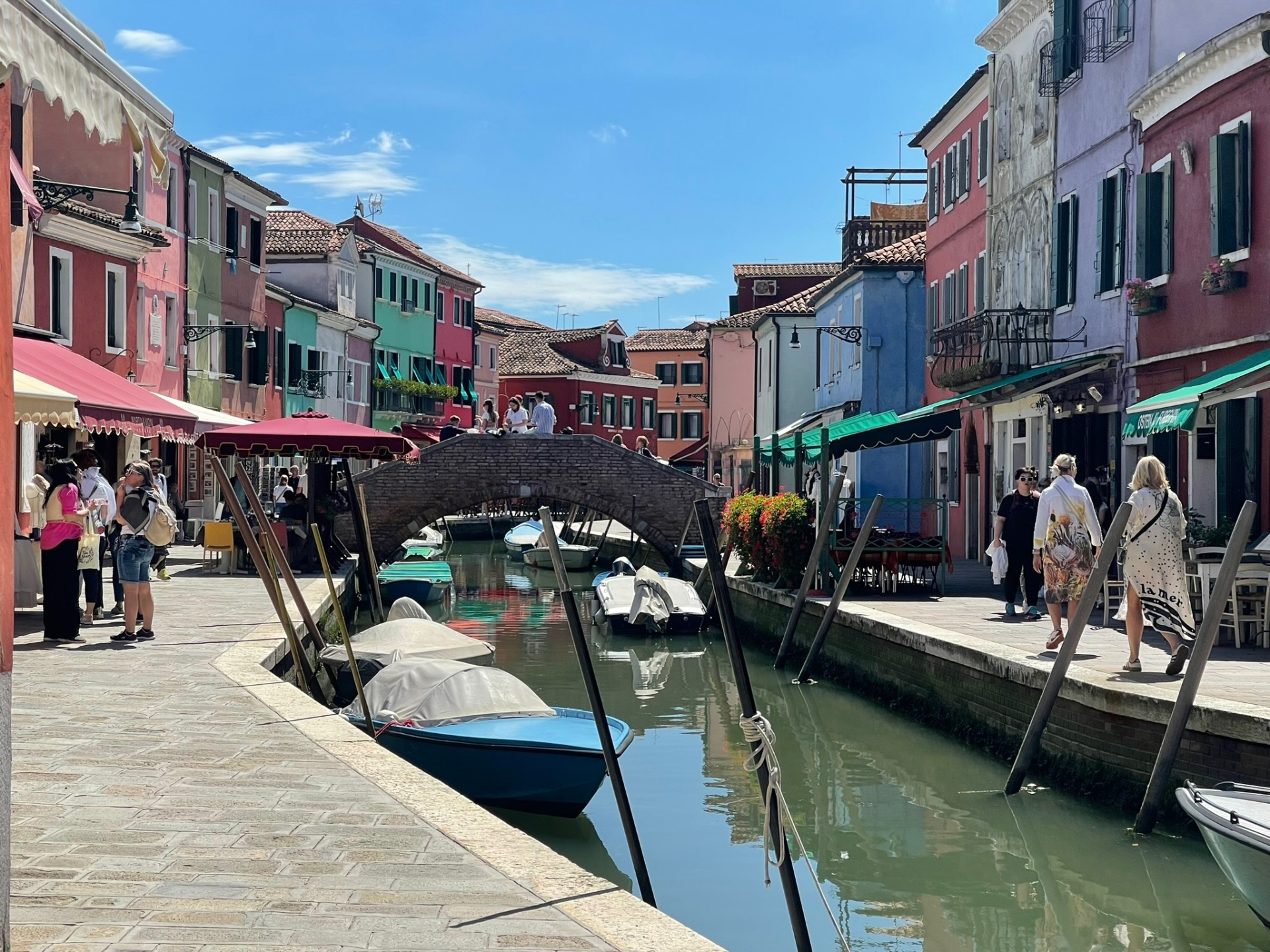
We did not arrive with a list of landmarks or shops. We had seen photographs of the brightly colored houses, thought the island looked beautiful and wanted to walk through it ourselves. We are often drawn to places that are visually interesting — we enjoy walking, looking and photographing more than moving through a full schedule of museums. Burano delivered the color and atmosphere that interested us. Would it be worth part of every traveler's only full day in Venice? Not necessarily. For our travel style, it was exactly the right choice.
What We Ate
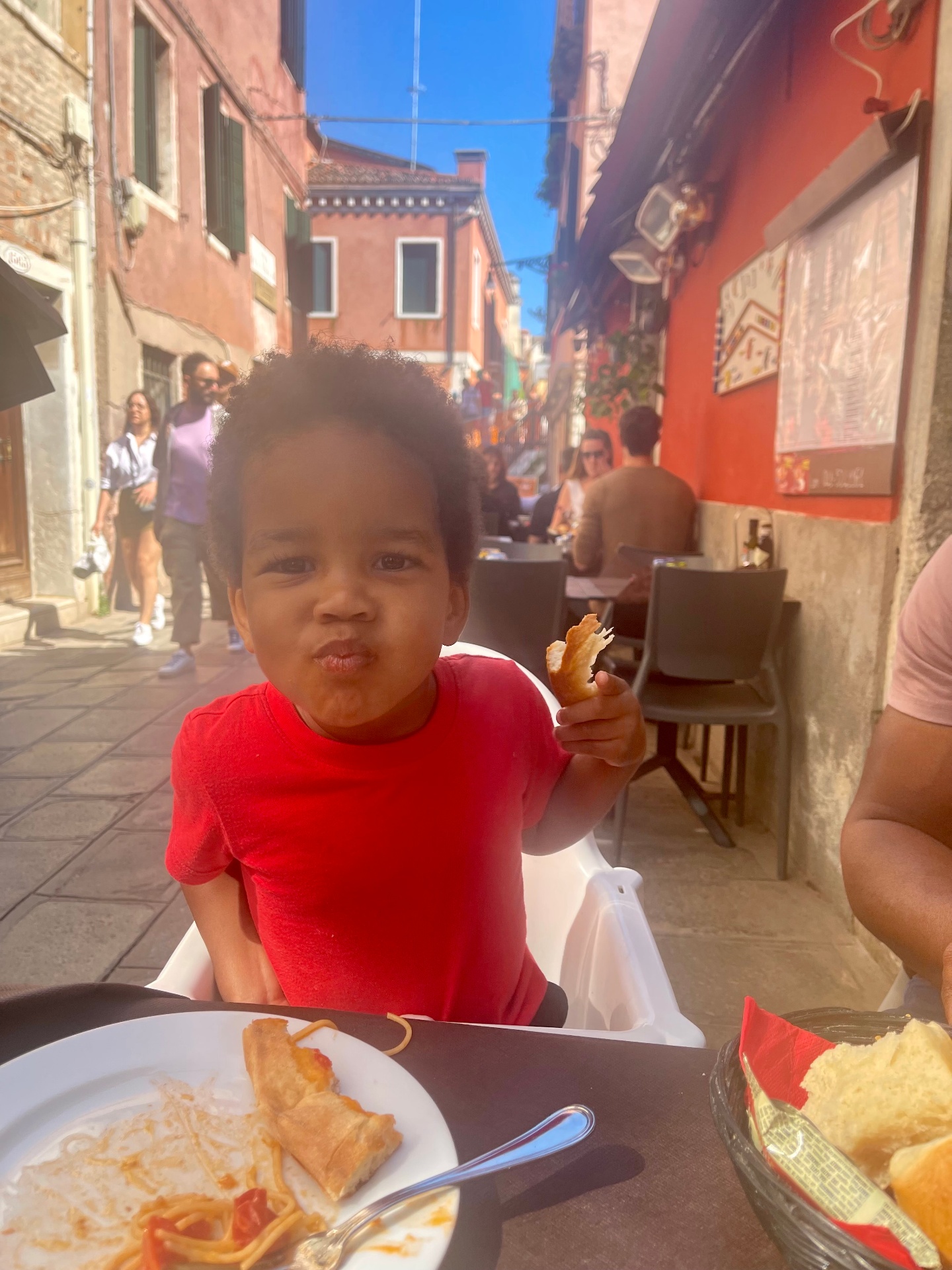
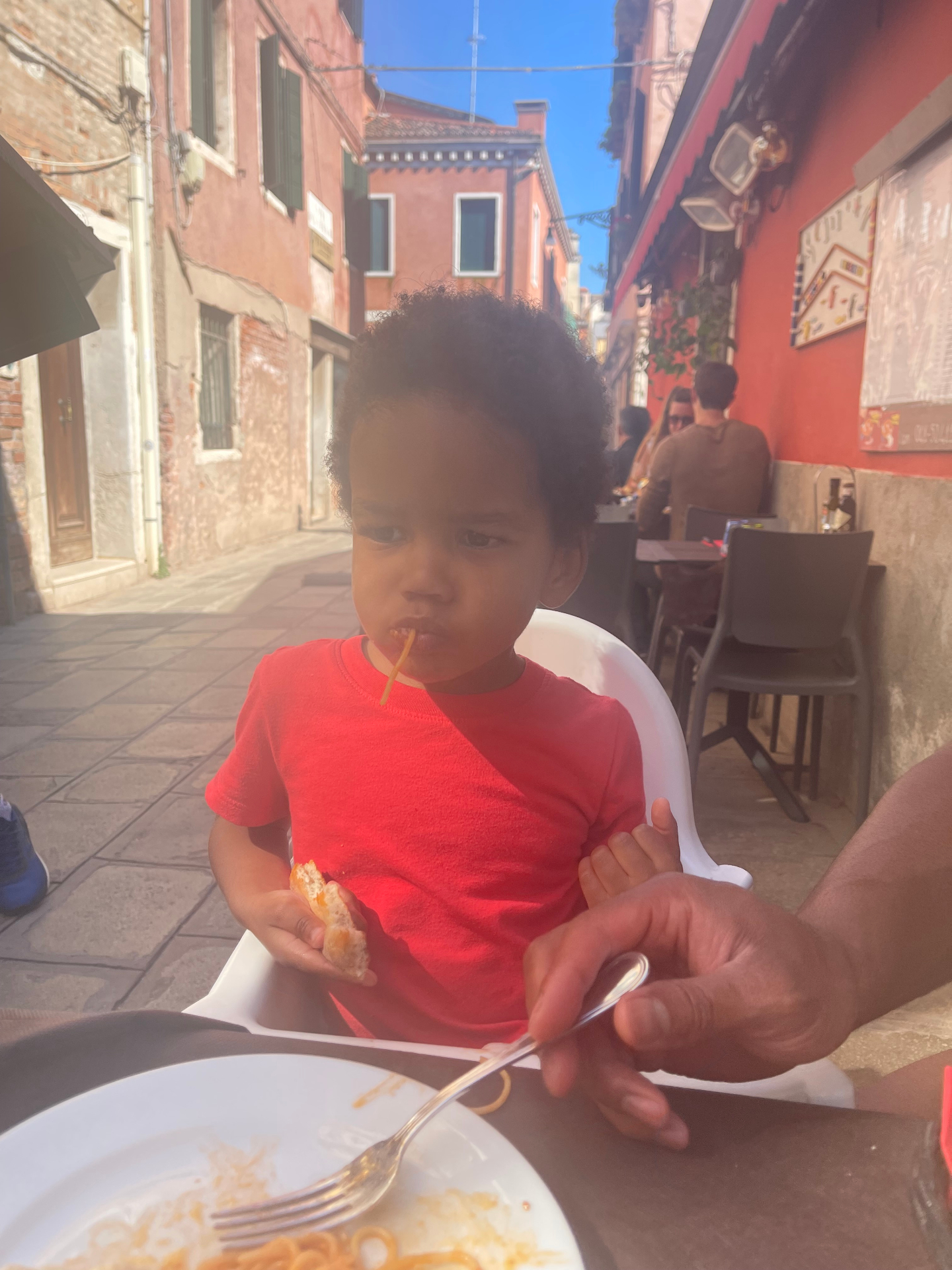
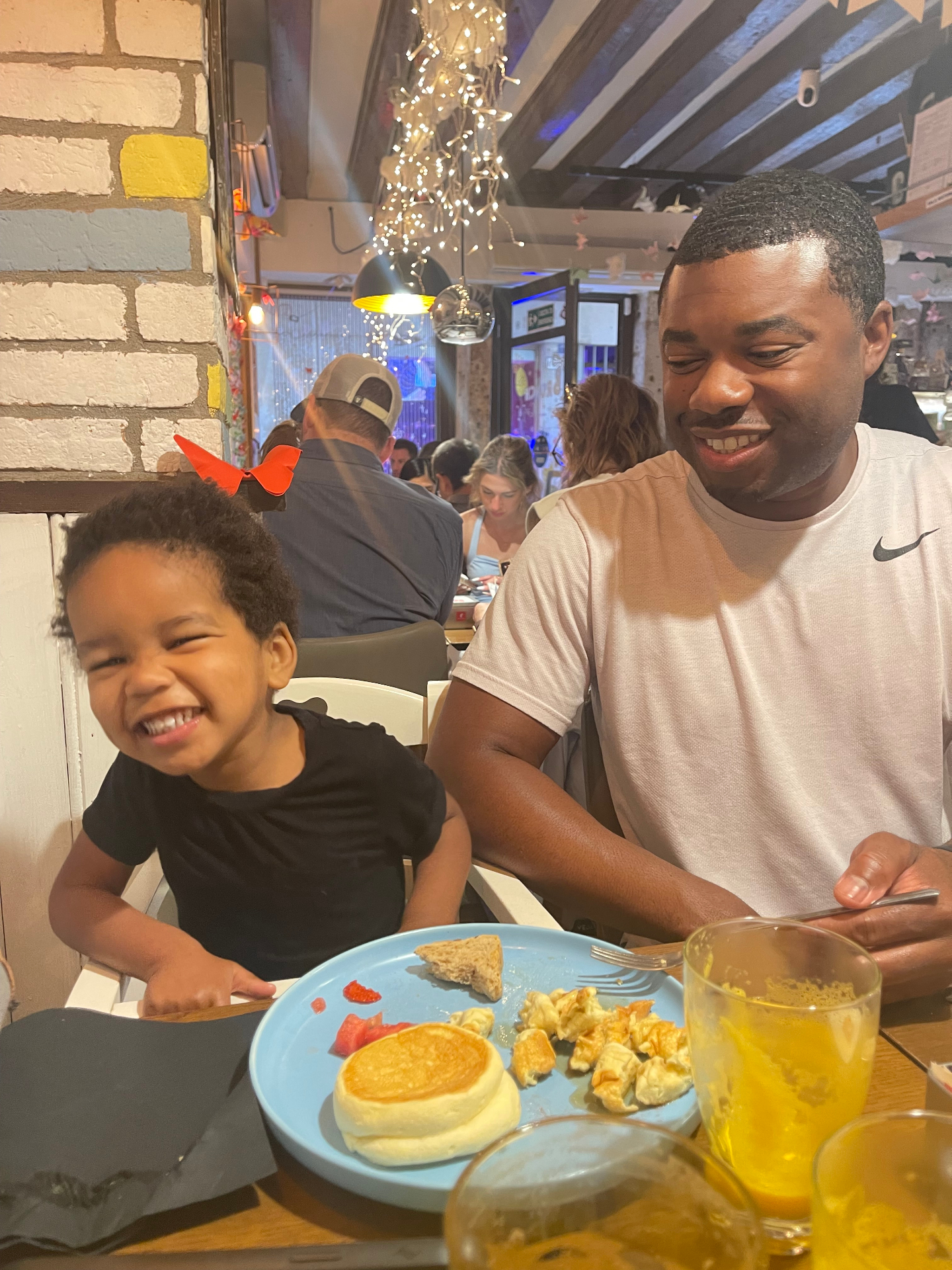
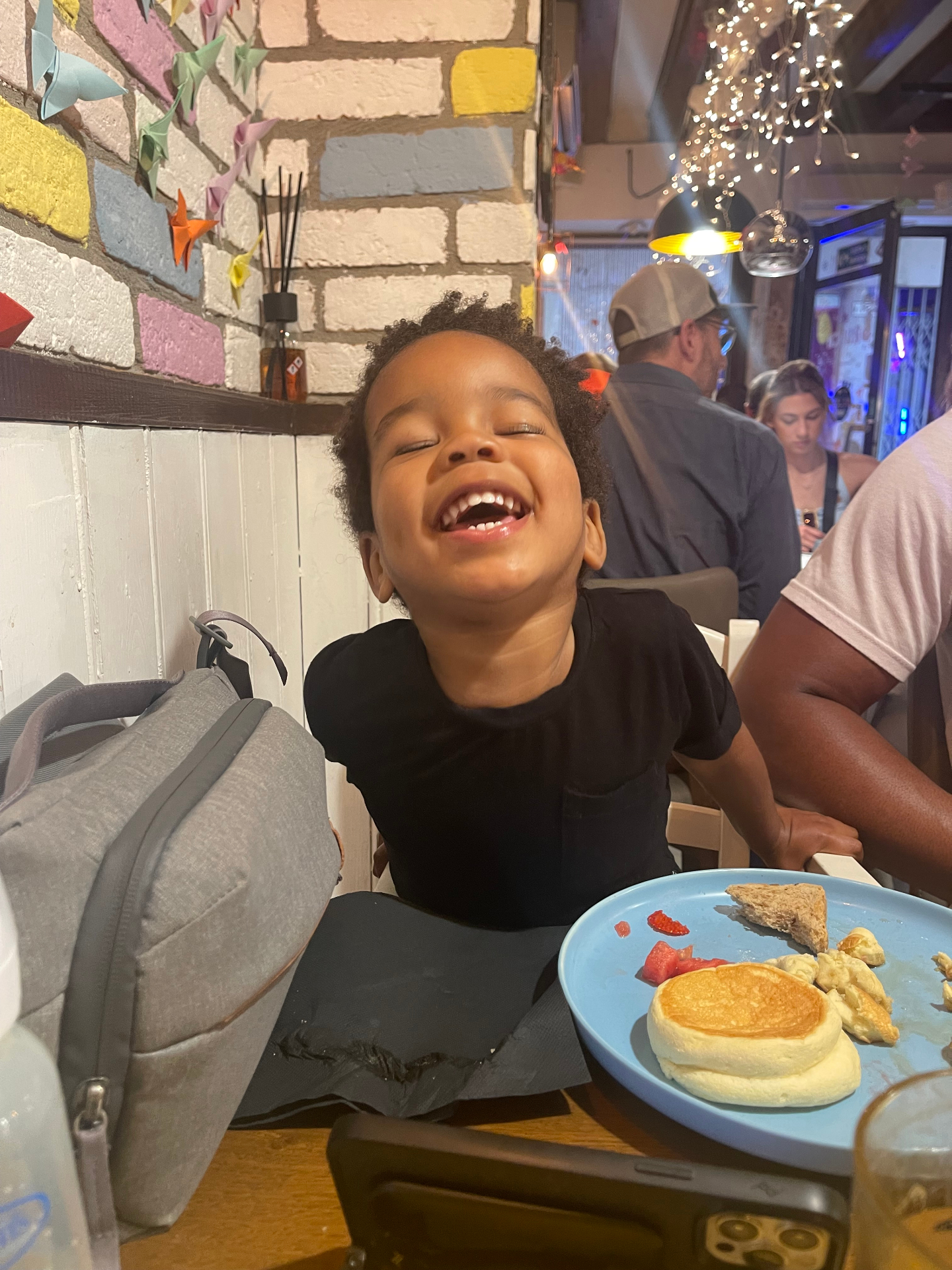
Venice was not the food chapter of this journey. The food was good, and every meal did what we needed it to do — but Bologna came next, and Bologna became extraordinary. Rather than make Venice's meals compete, we remember them as easy parts of a short stay. Loris recommended Trattoria Al Campanile while we waited for the apartment, and pizza and wine became a comfortable first welcome to Italy. We ate cicchetti — small Venetian tapas — while walking through Burano. After returning to Venice, we had dinner at Ae Oche Pizzeria, where a small tunnel nearby let Preston move; he ate both pizza and spaghetti, and watching him slurp noodles was a successful family dinner. On departure morning, Brunch Café gave Preston the tall, fluffy pancake stack I had hoped to find. And the small gelato stand in Campo San Polo became our repeat stop — some of the best food memories are attached to a routine rather than a reservation.
Traveling with a Toddler and an Infant
Venice was manageable with a toddler and infant because we understood what the city would ask from us. We would not complete every museum, enter every major building or maintain the exact rhythms we followed at home. We would carry equipment over stairs, remain vigilant around canals and let sleep happen wherever the boys could find it. That did not make the trip lesser. It made the expectations honest.
The Stroller Worked — With Lifting
We used Avery's travel stroller more than we expected. Venice was not stroller-friendly in the conventional sense, but the stroller remained useful between bridges and gave Avery a place to sleep. Every bridge required the same calculation: lift, carry over the steps, place down. It worked because we accepted the lifting before we arrived, not because the terrain changed for us.
The Hiking Carrier Solved Two Problems
Preston spent much of the visit in the hiking carrier on our backs. It helped us move efficiently and reduced the safety concern created by open canals. He had fewer chances to run independently than we'd prefer, so we looked for safer squares — Campo San Polo and areas on Burano — where he could get down and move.
Potty Training & Sleep in Motion
Preston had begun potty training a few months before the trip, and a travel day did not pause the process. We prompted him regularly and looked for bathrooms before the need became urgent. Potty training added more stress than traveling with the infant, largely because it required anticipation and cooperation from a child developing strong preferences. Avery, meanwhile, napped in the stroller, soft carrier and vaporetto; instead of forcing a formal afternoon sleep for Preston, we ended the evenings earlier.
Family-friendly does not always mean equipment and attractions. Sometimes it means someone saying, "You've got it, Mama."
On our full day, Kyle stepped away with Preston to get a sandwich and Avery began crying and did not stop. I was in a square near the Rialto Bridge, trying to retrieve milk, organize the bottle and calm a baby who had reached the end of his patience. Several women passed and offered encouragement — they told me I had it, that he would be okay. They did not need to solve the problem for the kindness to matter.
Exclusively Pumping Abroad
Exclusively pumping shaped every day of this trip, including Venice. At home I followed a stricter schedule; abroad, I had to preserve the purpose of the routine without letting the clock control every experience. I generally pumped in the morning before we left, once mid-day, once before dinner and again before bed — roughly three to five sessions a day. When I needed the Spectra Gold during the day, I returned to the apartment; the central location made that possible. We brought multiple sets of parts so one could dry while another was in use, and the apartment's kitchen, refrigerator and freezer turned out to be some of its most valuable family features. We also removed pressure by acknowledging a backup: babies live in Italy, and formula exists there. We never needed it — but knowing we could made it easier to adapt without treating every shift in timing as a crisis.
What Worked for Our Family
- Bringing the same Spectra Gold pump used at home.
- Packing multiple sets of parts, bottles, a brush, familiar soap and cleaning supplies in a dedicated backpack.
- Using the Ceres Chill system and ice packs for milk produced during travel days.
- Choosing an apartment with a kitchen, refrigerator and freezer.
- Returning to a centrally located apartment for daytime pumping.
- Keeping the routine consistent enough to maintain supply while allowing the timing to flex.
- Knowing formula was available if feeding needs changed.
The Itinerary We Did Not Force
We did not enter St. Mark's Basilica. We did not tour the Doge's Palace. We did not visit a museum. We saw the famous buildings from outside and allowed that to be enough for this version of the trip. The goal was not to complete Venice — it was to arrive, experience the waterways, walk through the city, see the places that interested us and continue into the larger month without exhausting the family at the beginning.
Why We Skipped the Gondola
We considered a gondola ride before leaving home and ultimately chose the private water taxi from the airport instead. The experiences are not the same, but the water taxi satisfied the desire beneath the gondola idea: we wanted to see Venice from the water. A gondola would have been an additional expense and a fixed experience — if both boys lost interest, we would still be sitting in the boat trying to make the moment feel worthwhile. The airport transfer had to happen regardless. It gave us the view without asking the boys to cooperate with one more activity.
A trip does not become more complete simply because the family completes more activities.
Leaving Venice — and Hiring the Porter
Departure morning began with pancakes and ended with the single best logistical decision we made in Venice. Our Trenitalia train would leave Venezia Santa Lucia at 11:26 a.m. and reach Bologna Centrale at 12:59 p.m. Once we had experienced Venice on foot, we understood that reaching the station with all our gear would be very different from the short walk after the water taxi — the route required repeated bridges and stairs while moving two kids, the stroller, two car seats, two suitcases, backpacks, pumping supplies and the hiking carrier.
We contacted our host, who provided a porter's contact information. The porter carried almost everything — suitcases, car seats and the rest of the loose load. He moved through Venice as though the route had no friction: up stairs, down bridges, around tight corners and through passages we would have needed to stop and confirm. With everything we had, we might not have reached the station on time. We do not remember the exact cost. We remember that it was worth every penny.
The City, the Logistics & the Honest Part
What Surprised Us
We had watched enough travel content that very little about Venice surprised us in a practical sense — we expected stairs, bridges, narrow streets and water transportation. What no preview could fully communicate was how cool the city felt once we stood inside it. The absence of vehicles was not a small atmospheric detail. It changed the entire experience of moving through the destination.
What Photographs Do Not Show
Photographs show the canal after the stroller has been lifted over the bridge. They show the baby sleeping after someone has pumped, prepared the bottle and stored the milk. They show the family at the Rialto Bridge without showing the car seats waiting in the corner of an apartment several floors up. They also cannot communicate the navigation — a route that looked direct could divide into narrow passages or lead toward several nearby docks.
Did We Feel Safe and Welcome?
Yes. We felt comfortable in the city and did not experience flooding, aggressive crowds or the other complaints that often dominate conversations about Venice. The weather was nearly perfect. I felt comfortable walking alone early in the morning while remaining alert. As a family, we felt welcomed in restaurants and public spaces — the strangers who encouraged me during Avery's crying episode remain one of the clearest examples.
The Honest Part
Two nights was enough for us because we wanted to see Venice, not deeply study it. We experienced the Grand Canal, Rialto Bridge, St. Mark's Square, the Doge's Palace exterior, Cannaregio and Burano; we entered by private boat, used the public vaporetto and left by train. A traveler who loves museums, churches and slow immersion could spend a week and still feel unfinished — our itinerary would be entirely too short for that person. The limitation was not a planning failure. It was the point. Venice opened a month-long journey; we wanted to leave interested and capable of continuing.
We did not complete Venice. We experienced the version that fit our family.
What We Would Repeat & Change
What We Would Do Again
- Use Venice as the first stop when the airfare and larger route make it a practical gateway.
- Book the private water taxi from Marco Polo and treat the transfer as the first experience of the city.
- Stay near Campo San Polo and the Rialto Bridge for a central, walkable base.
- Choose a two-bedroom apartment with a kitchen, refrigerator and freezer while traveling with an infant.
- Let the early riser experience the Rialto Bridge and St. Mark's Square before the crowds.
- Use the hiking carrier for a toddler beside canals and the stroller for an infant — while expecting to lift it over bridges.
- Take the Line 12 vaporetto to Burano.
- Keep interior tours and ticketed attractions off the schedule when they are not a family priority.
- Arrange a porter for the walk to Venezia Santa Lucia.
- Purchase a train seat for the toddler even when a separate seat may not be strictly required.
What We Would Change
Very little. The two-night stay accomplished exactly what we wanted. If anything, we might arrange the departure porter before arriving instead of waiting until the terrain made the need obvious — securing both the water taxi and porter in advance would reduce one more decision during the stay.
Who Is This Trip For?
Our two-night Venice itinerary may fit travelers who want a visually rich introduction rather than an exhaustive cultural itinerary; enjoy walking, photographing and observing the character of a place; are comfortable seeing major landmarks from outside; want to pair Venice with a longer northern Italy or central European trip; can carry a stroller over bridges or use a child carrier; and are willing to keep the schedule flexible around infant feeding and toddler energy. It may disappoint travelers who want meaningful time inside St. Mark's Basilica, the Doge's Palace and museums, or families whose mobility needs make repeated stairs and bridges especially difficult. Two nights should be understood as a deliberate introduction, not a complete guide.
Would We Return?
We do not feel an urgent need to repeat the same Venice trip. That is not a negative verdict — we saw what we wanted to see, enjoyed the city and left satisfied. Venice worked as the opening chapter rather than the destination we needed to explore for a full week. We may still return through Venice Marco Polo Airport: later in this trip, the Cavallino Bianco in Ortisei became one of our favorite family-hotel experiences, and the brand's family resort in Caorle, near Venice, now interests us.
For now, Venice feels complete without feeling closed.
What Venice Left With Us
Venice taught us that traveling as a family of four was possible. We made it across the Atlantic with a toddler, a three-and-a-half-month-old infant, two car seats, pumping equipment and enough belongings to begin more than 30 days in Europe, and we navigated a city with real logistical challenges successfully. The accomplishment was not that every moment went smoothly. Avery cried in a public square. The pumping schedule followed us onto the airplane. The stroller had to be lifted. The apartment required several flights of stairs. We still did it.
Traveling with two children was not simply traveling with one child plus another body. Our family had become a different unit. The adults divided nights, the older child needed independence and boundaries, the infant needed food and closeness — every outing asked us to consider four people instead of three.
We arrived as a newly expanded family. We left knowing that four of us could go.
Venice gave us a setting dramatic enough to mark that transition. We left an airport by boat and watched an impossible-looking city rise from the water. That arrival became the image of the chapter: the four of us moving toward something new together.
Travel Thoughtfully. Explore Together.
Venice was the place where our family learned to travel as four.
Practical Planning Guide
Everything we booked, packed and learned in Venice — gathered in one place so you can plan your own version of the trip.
Where We Stayed
- Cozy Two Rooms Apartment · Campo San PoloHosted by Loris, just off Campo San Polo — two bedrooms, central location, kitchen, refrigerator, freezer, small common area and nearby bag storage before check-in.
- What Required PlanningSeveral flights of stairs, no elevator, and only one available child item — a pack-and-play for an additional fee.
- Why the Location MatteredThe ability to walk to major views and return to the apartment for pumping.
What We Did
- Arrived by private water taxi from Marco Polo Airport.
- Walked to the Rialto Bridge and Grand Canal; experienced St. Mark's Square and the Doge's Palace exterior on a 6:30 a.m. solo walk.
- Walked Cannaregio, stopped at an impromptu concert and a puddle-jumping break.
- Took the Line 12 vaporetto past Murano to Burano and walked without a formal itinerary.
- Ate at Trattoria Al Campanile, Ae Oche Pizzeria and Brunch Café; skipped gondolas, museums and interior tours.
- Hired a porter for the route to Venezia Santa Lucia and continued to Bologna by train.
What We Packed or Arranged for the Boys
- Travel stroller system with Avery's infant car seat; soft carrier for Avery; hiking carrier for Preston.
- Preston's car seat, used aboard the flight and later in the rental car.
- Portable diaper-changing pad and ordinary diapering supplies.
- A pack-and-play arranged with the host for an additional fee; three train seats so Preston had his own space.
What We Packed for Pumping
- Spectra Gold and Elvie Stride pumps — the same primary pump used at home.
- Multiple sets of pump parts and bottles; bottle brush, familiar soap and cleaning supplies.
- Ceres Chill milk-storage system and additional ice packs.
- A dedicated backpack containing the pump, parts, cleaning tools and feeding supplies.
What We Booked in Advance
- Delta flights from Columbus through Atlanta to Venice; bassinet request initiated with Delta and completed at the gate.
- The two-bedroom apartment near Campo San Polo.
- Consorzio Motoscafi Venezia private water taxi, reserved April 2024.
- Trenitalia journey to Bologna, purchased through ItaliaRail near the end of April.
Our Most Helpful Advice
Choose the arrival and departure plans before filling the itinerary — in Venice, moving luggage is not a small footnote. Bring a stroller only if you are physically prepared to lift it. Select accommodation based on the family systems it needs to support: a refrigerator and freezer mattered because I was pumping, two bedrooms mattered because we divided the night, a central location mattered because I returned during the day. Finally, decide what seeing Venice means to you.
Venice opened a month-long journey. We wanted to leave interested and capable of continuing.